A new study links cleaner London air with improved lung growth in children. DfT now wants tougher control of vehicle emissions for the whole life of a car. The health case deserves attention. The engineering behind the proposed law needs much more work.
ULEZ has handed government a powerful headline. Children living in central London showed faster lung function growth after the introduction of the Ultra Low Emission Zone than children studied in Luton.
That sounds decisive.
Read the research itself and the picture becomes much more interesting.
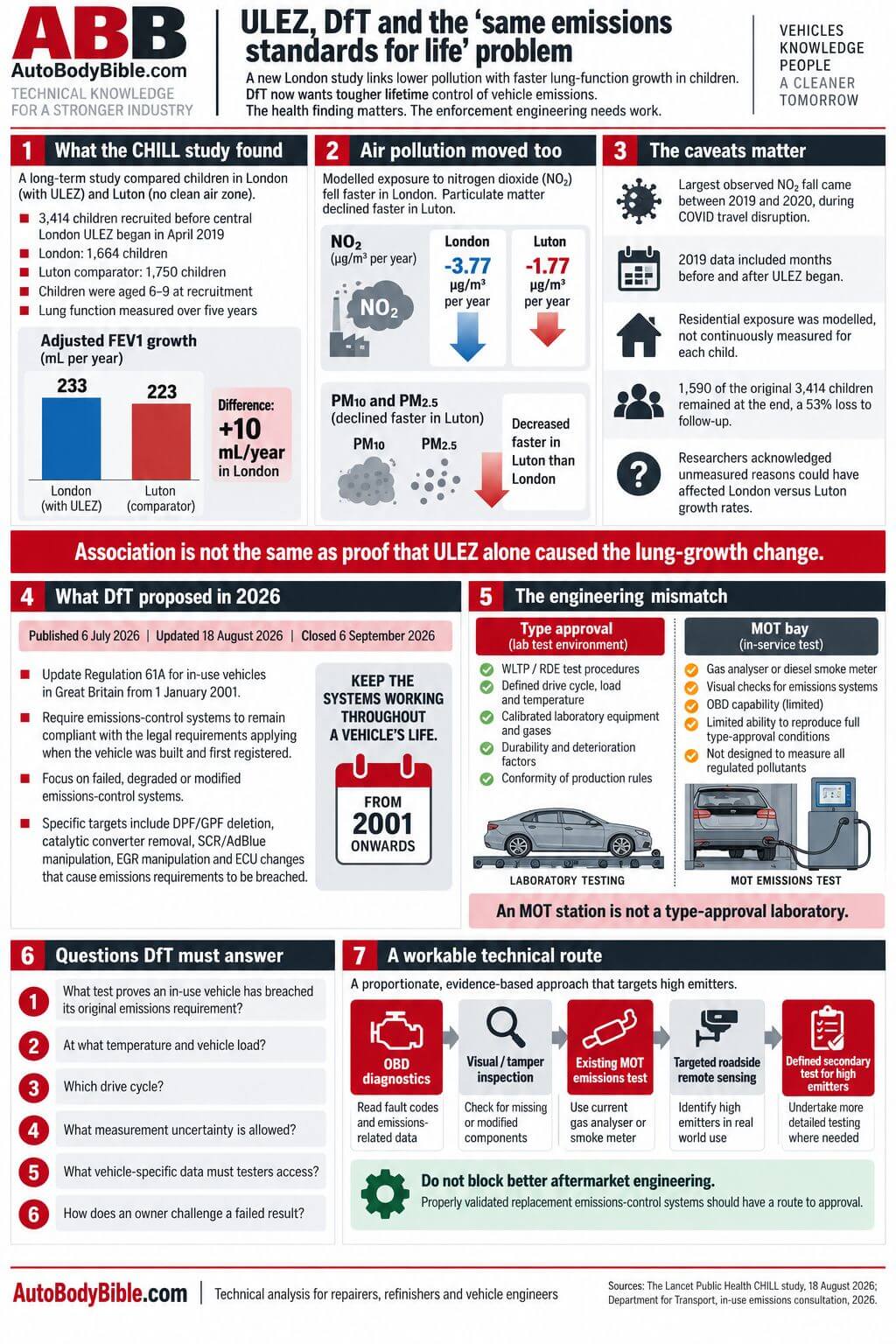
The Children’s Health in London and Luton study followed 3,414 children, recruited before the central London ULEZ started in April 2019. Researchers compared children in London with children in Luton, where there was no clean air zone. Lung function was assessed using spirometry over five years.
At the start, adjusted FEV1, the amount of air that can be forcibly exhaled in one second, was 38 mL lower among the London children.
During the study, FEV1 grew at 223 mL per year in Luton and 233 mL per year in London. That additional 10 mL per year meant average FEV1 in the two groups had reached near-identical levels by the end of the study.
Important evidence. But it is evidence of an association, not a laboratory demonstration that ULEZ itself caused the change.
The researchers say that in their own limitations.
The ULEZ result has some large caveats
Nitrogen dioxide exposure fell faster in London. The model estimated an average reduction of 3.77 µg/m³ per year in London against 1.77 µg/m³ in Luton.
Particulate matter behaved differently.
PM10 and PM2.5 declined faster in Luton than London. That matters when a public health argument is being used to support tighter control of the complete vehicle emissions system.
Then comes COVID.
The paper states that the largest observed fall in NO2 occurred between 2019 and 2020 during COVID-related travel disruption. Annual median NO2 values then largely plateaued. The researchers also state that the 2019 figure contains months before and after ULEZ implementation.
That makes a simple before-and-after ULEZ interpretation impossible.
Exposure was modelled from residential addresses rather than continuously measured for each child. People travel, attend school, spend time indoors and breathe air away from their home address.
There was substantial attrition too. Of the original 3,414 children, 1,590 remained at the end, a loss of 53%. The researchers tested for bias and found no evidence that incomplete follow-up materially changed the pollution relationship. The limitation still exists.
Most significantly, the authors acknowledge that there may have been unmeasured reasons why London children experienced faster lung growth than those in Luton.
So the headline should be:
Lower pollution was associated with better lung growth.
Not: ULEZ has proved that charging older cars makes children’s lungs grow.
Those are very different statements.
Then DfT enters the workshop
Running alongside this is the Department for Transport consultation on in-use vehicle emissions.
DfT proposes updating Regulation 61A so vehicles first used from 1 January 2001 continue to comply with the emissions requirements applying when they were manufactured. It makes no distinction between excessive emissions caused by poor maintenance, deliberate modification or an unintended consequence of modification.
The department specifically targets:
- DPF and GPF deletion
- catalytic converter removal
- SCR and AdBlue manipulation
- EGR manipulation
- ECU changes that cause emissions requirements to be breached
There is an important distinction here.
Removing a DPF is already an MOT problem. DVSA has required DPF presence checks since 2014, and current MOT rules classify missing, obviously modified or defective manufacturer-fitted emissions equipment as a major defect. Diesel testing also includes smoke opacity testing.
DfT’s proposal goes further. It seeks stronger legal powers against vehicles, owners and businesses involved in emissions-control modification, with enforcement expected to sit with DVSA.
And this is where engineering collides with legislation.
What exactly are you going to test?
Vehicle type approval emissions limits are not generated by putting a probe up the exhaust of a parked car.
They come from defined test procedures, operating temperatures, drive cycles, loads and, on newer vehicles, real-driving emissions testing.
Vehicle ageing is part of that system too.
Euro legislation includes emissions-system durability requirements, deterioration factors and in-service conformity procedures. Euro 5 introduced durability testing extending to 160,000 km, and in-service conformity requirements have historically covered vehicles to 100,000 km or five years.
Conformity of production also recognises that series-built vehicles are assessed through prescribed procedures and sampling. Every car leaving a production line is not expected to reproduce an identical laboratory number.
That does not mean government must retrospectively type approve every vehicle in Britain. Parliament can create an in-use offence.
It does mean DfT needs a defensible method of proving that offence.
An MOT station has a gas analyser or diesel smoke meter. It does not have a WLTP emissions laboratory.
DfT admits the present roadworthiness test can assess only limited aspects of emissions and says enforcement is likely to focus upstream on businesses supplying or carrying out illegal modifications.
That admission goes straight to the technical weakness.
If an owner is prosecuted because a 12-year-old diesel allegedly no longer complies with its original Euro standard, what test establishes that?
Under what temperature?
At what vehicle load?
Using what drive cycle?
What allowance applies for measurement uncertainty?
What vehicle-specific data will the tester require?
How will an owner challenge the result?
Those questions need answers before the legislation goes live.
Do not accidentally outlaw better engineering
There is another trap.
A failed original emissions-control component should not automatically mean the only acceptable replacement is the technology installed by the manufacturer years earlier.
Aftermarket engineers may develop replacement systems that work better, last longer and still meet the applicable emissions requirements.
The consultation response submitted to DfT argues that properly validated replacement technology should remain legal where its emissions performance and durability can be demonstrated through an accepted approval process.
Germany’s TÜV approach provides one model. Modification is permitted, but engineering changes can require technical verification.
A stronger British system could combine vehicle-specific diagnostic information, OBD interrogation, component and tamper inspection, existing MOT emissions measurements and targeted roadside remote sensing. Vehicles flagged as serious outliers could then undergo a defined secondary test.
That would target genuinely defective and manipulated vehicles without pretending an MOT bay is a type approval laboratory.
DfT’s own evidence points towards targeting high emitters. Its consultation cites remote-sensing work based on more than 94,000 measurements. Those field campaigns date from 2016 and 2017, long before much of the later Euro 6 fleet entered service. The original research focused on identifying high-emitting subsets of the fleet.
There is a useful policy idea buried in there.
Find the dirty vehicles. Identify failed or defeated emissions systems. Repair them. Act against businesses deliberately selling illegal deletes.
But write a test method first.
Clean-air policy can stand on proper science. It does not need loose engineering to support it.
If DfT wants a vehicle to retain its legally required emissions performance throughout its working life, owners, repairers, aftermarket manufacturers, MOT testers and courts need one thing above everything else: a reproducible technical definition of what passing actually means.
Until DfT provides that, ‘same emissions standards for life’ is a policy statement waiting for an engineering specification.
Publication note
The DfT consultation was first published on 6 July 2026 and updated on 18 August 2026, the same day the CHILL study was published. It closed on 6 September 2026. The consultation does not propose a blanket ban on performance exhausts. It targets modifications that cause a vehicle to breach its emissions requirements.
Reference material
- Wood HE et al., The Lancet Public Health, 18 August 2026: Impact of the Ultra Low Emission Zone on lung function growth in children in London, UK: a prospective parallel cohort study.
- Department for Transport consultation, 2026: In-use emissions of road vehicles: regulating environmental impacts.
- Andrew Marsh consultation response, 6 September 2026: Response to the DfT consultation on in-use emissions.
- Greater London Authority report, 2021: Air Pollution and Inequalities in London: 2019 Update.
- Ghaffarpasand O et al., Science of the Total Environment, 2023: Detecting high emitting vehicle subsets using emission remote sensing systems.