The UK collision repair industry has reached a point that would have sounded absurd ten years ago.
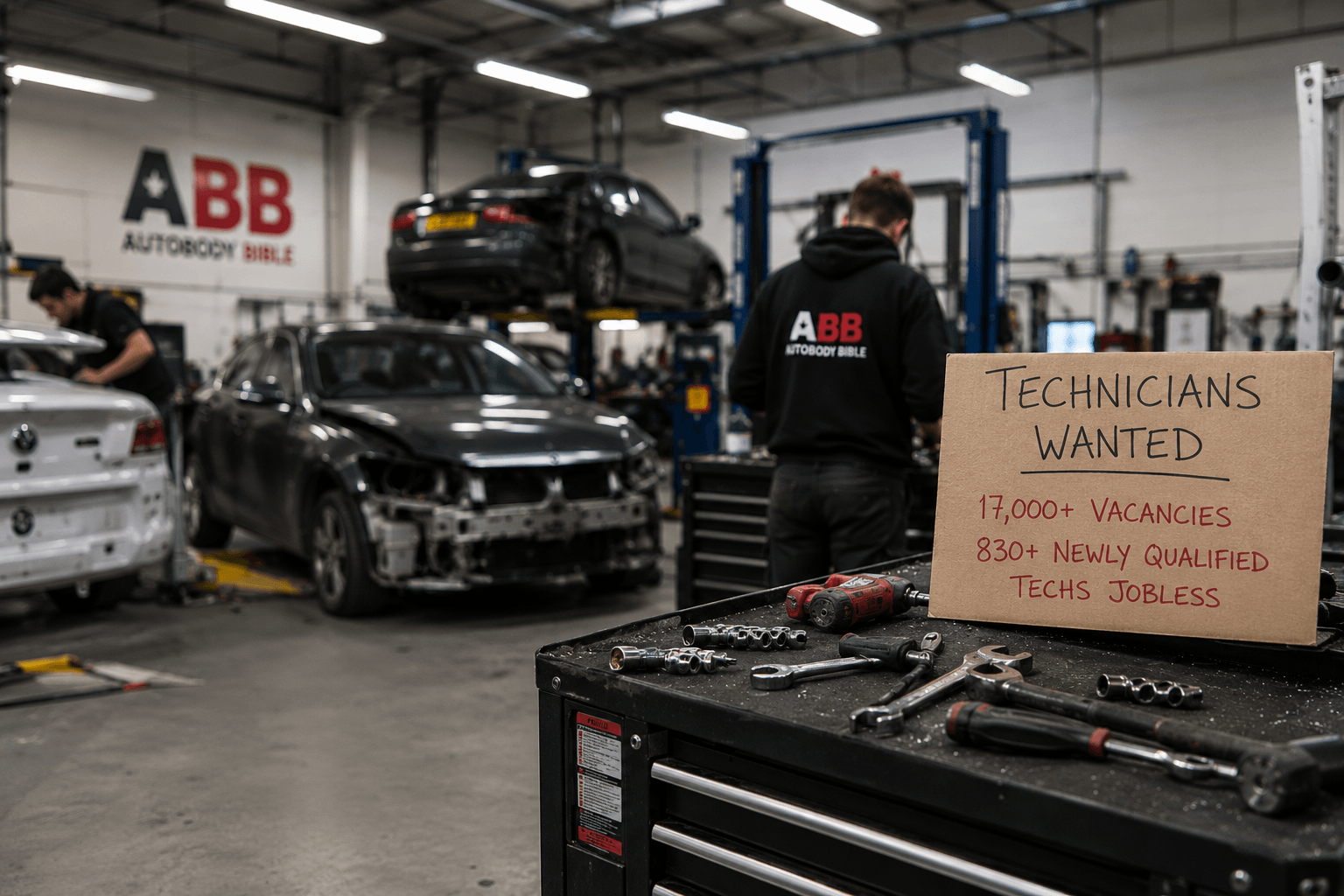
Bodyshops are desperate for technicians. Vacancy numbers across the automotive sector remain stubbornly high, with industry estimates still hovering above 17,000 unfilled roles nationwide. Yet at the same time, more than 830 newly qualified automotive technicians have reportedly struggled to secure permanent employment after finishing training programmes.
The contradiction exposes something deeply broken inside the industry’s talent pipeline.
Every repair group talks about the skills crisis. Workshop owners complain they cannot recruit high voltage system (‘HV’) qualified staff to deal with ever increasing numbers of HEVs, PHEVs and BEVs entering the UK market. Insurers complain about repair delays and capacity shortages. Customers complain about vehicles sitting for weeks awaiting repair slots.
Yet hundreds of newly trained people remain stuck outside the workshop gates, unable to secure the “first chance” placement that turns training into a career.
For an industry facing technical upheaval on almost every front, that failure is becoming dangerous.
The modern bodyshop barely resembles the repair environment many senior technicians entered twenty or thirty years ago. Vehicle structures have changed radically. Steel alone no longer dominates repairs. Aluminium, bonded composites and ultra high-strength materials now sit alongside increasingly sensitive electronics and software-driven systems.
Then came electrification.
An HV-capable repairer today needs far more than panel knowledge and paint experience. Technicians are expected to understand battery isolation procedures, high-voltage safety protocols, radar positioning, calibration tolerances and complex scan diagnostics, often while working within tightly controlled OEM repair methods.
The labour shortage is no longer just about headcount. It is about capability.
That distinction matters.
A workshop may technically have enough people on the payroll while still lacking the certifications required to maintain insurer approvals or manufacturer programme status. Increasingly, insurers and OEMs want proof of accredited competence through organisations like the Institute of the Motor Industry and Thatcham Research.
Without those qualifications, repair networks become vulnerable.
Several larger repair groups privately admit staffing concerns now shape commercial decisions as much as repair volume itself. There is little value securing additional insurer contracts if you cannot resource the work compliantly.
That pressure is driving wage inflation across parts of the sector.
Experienced HV and ADAS-capable technicians are increasingly treated like scarce strategic assets. Recruitment competition between repairers has intensified sharply over the past three years, particularly in urban regions with heavy insurer network concentration. Some workshops report technicians moving between businesses for relatively small salary increases simply because qualified staff remain so difficult to replace.
The side effect is instability.
High turnover disrupts training continuity, slows repair quality consistency and creates management fatigue inside workshops already struggling with rising operational pressure.
Still, the industry’s biggest frustration is not simply the shortage itself. It is the growing belief that the training pipeline does not properly connect with workshop reality.
That criticism surfaces repeatedly when bodyshop owners discuss newly qualified entrants.
Many employers argue training environments remain too detached from modern repair conditions. Students may leave programmes with theoretical understanding but limited exposure to production pressure, insurer processes, damaged EV handling or the pace of real-world collision repair environments.
Several repairers describe a growing mismatch between how automotive careers are marketed and what workshops actually need.
Young recruits are often introduced to the automotive sector through highly sanitised visions of future mobility, diagnostics and clean technology. The reality inside many collision repair facilities remains physically demanding, noisy and operationally intense. HV repair itself is not the clean laboratory-style process some entrants appear to expect. It still involves dismantling damaged vehicles, handling contaminated components and working within strict safety constraints under commercial time pressure.
That gap between expectation and reality contributes to attrition.
Some employers now believe the industry has spent too much time talking about recruitment and not enough time talking honestly about retention.
The workshops succeeding in this environment tend to share similar characteristics. They invest heavily in mentoring. They pair younger recruits with experienced technicians rather than treating apprentices as low-cost labour. They structure progression pathways clearly. They expose trainees to diagnostics, HV systems and calibration work early instead of locking them into repetitive low-value preparation tasks for years.
Those businesses increasingly view training as a commercial survival strategy rather than an just and exercise to recruit the required people.
A few larger repair groups are already building internal academies and structured reskilling programmes because they no longer trust the wider labour market to solve the problem for them.
That trend will accelerate.
The technical complexity entering modern vehicles leaves little alternative. ADAS alone has transformed repair planning. A relatively simple bumper repair can now involve radar calibration, camera alignment, software verification and post-repair scanning procedures that barely existed in mainstream collision repair a decade ago.
Every one of those tasks requires trained labour.
Meanwhile, the arrival of EVs created a second challenge. Much of the existing technician workforce still requires upskilling itself. Many experienced repairers built highly successful careers around conventional structural and mechanical repair but now face pressure to retrain around high-voltage systems and digitally integrated vehicle architectures.
That transition is not always comfortable.
Some senior technicians embraced it immediately. Others remain sceptical or fatigued by constant procedural change. Workshops are therefore attempting to solve two problems simultaneously, attracting new entrants while reskilling established staff before knowledge gaps become operational risks.
Government policy has struggled to keep pace with that reality.
The industry continues criticising fragmented apprenticeship support, inconsistent technical funding and insufficient incentives for businesses willing to take on trainees. Smaller independents often lack the margin flexibility or mentoring capacity to absorb inexperienced recruits, especially while cycle times and insurer pressures remain intense.
That creates another dangerous imbalance.
Large consolidators gain increasing control over training infrastructure while smaller independents risk falling further behind, both technically and commercially. The long-term danger is a repair sector split between heavily resourced corporate groups and struggling smaller operators unable to access skilled labour pipelines consistently.
For the UK repair industry, this is no longer a future concern.
It is happening now.
Every delayed repair, every empty calibration bay and every workshop turning away EV work because qualified staff are unavailable points to the same underlying issue. The sector is producing trainees but failing to integrate enough of them into sustainable careers quickly enough.
And with vehicle technology becoming more demanding every year, the cost of getting that wrong keeps rising.