As regular readers of Bodyshop Magazine will know, the Security-related Repair Maintenance Information approval system (SERMI) has been launched. There are appointed ‘conformity assessment bodies’ (CAB) for each country, and in the UK it is IGA.
The problem
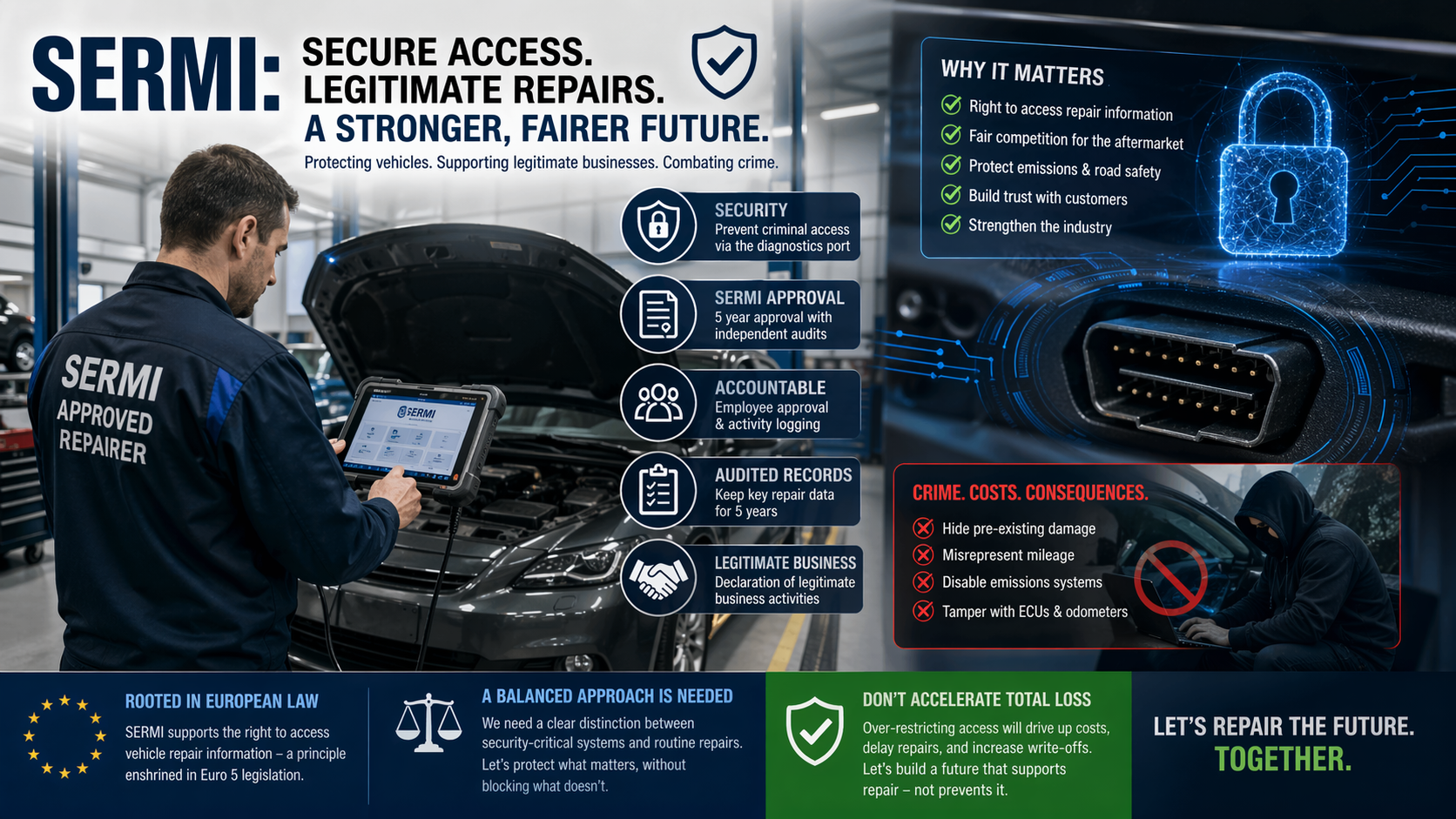
For some time there has been little protection from criminal activity via the diagnostics socket (EOBD / EOBD II) where nefarious individuals can do exactly the same things as a legitimate repairer such as hiding pre-existing damage or to mis-represent the milage covered. Indeed, just ‘making the lights go out’ on the instrument panel has long been a major reputational problem for vehicle manufacturers, insurers, warranty companies and the people who pay for the whole show… the public.
Vehicle manufacturer stand-alone initiatives were often quirky, often requiring vehicle manufacturer approved diagnostic tools. In practice recently introduced models could involve moving the wreck or completed repaired vehicle back and forth to a local manufacturer approved repair shop. Time consuming, expensive and, let’s face it, not always successful.
The root cause is collision repair is not routine maintenance, with systems requiring software access beyond what most maintenance outlets come across.
The proposed solution
SERMI places the collision repairer, upon signing up, with the ability to access repair information direct from the vehicle manufacturer website, along with software access. It does not change the way the vehicle manufacturer websites work.
The approval is valid for 5 years and includes two independent audits, with annual fees. Business employees also have to be approved, and can only access information in connection with their employer’s business. As part of the approved process, the business has to sign and return a declaration the company pursues ‘legitimate business activities’.
From the IGA:
In accordance with the SERMI Standard, this means that the business does not offer services which would ‘negatively impact the emissions performance of a vehicle’. This includes:
- Deactivating or removing pollution control devices or emission control systems, or degrading their performance or concealing their malfunction
- Installing defeat devices (any element of design which senses temperature, vehicle speed, engine speed (RPM), transmission gear, manifold vacuum or any other parameter for the purpose of activating, modulating, delaying or deactivating the operation of any part of the emission control system, that reduces the effectiveness of the emission control system under conditions which may reasonably be expected to be encountered in normal vehicle operation and use)
- Installing defeat strategies (an emission control strategy that reduces the effectiveness of the emission controls under ambient or engine operating conditions encountered either during normal vehicle operation or outside the type-approval test procedures)
- Deactivating, removing or tampering with devices for the monitoring of the consumption of fuel or electric energy, or tampering with odometer readings
- Tampering with the engine control unit, including the rated engine power
SERMI requires the registration number, make / model / year, mileage, reason for repair and customer signature, to be kept for 5 years. This is what the audit will concentrate on.
The reality:
- Fees are still due to access vehicle manufacturer websites, along with the website specific application processes. This includes removal and refit information as well as software.
- Use of third-party diagnostics such as Target, Bosch, Texa et al is possible – they have to agree to SERMI as well.
- There will be an operational on-cost, although this is relatively small.
Why should we care?
There are several aspects.
In Europe right to access vehicle repair information by independent automotive aftermarket businesses in exchange for fees was made law under ‘sister’ legislation related to Euro 5 emission regulations. This vehicle manufacturers would rather most of the work would remain in their dealer network even if they do not have the capacity or, in some cases, the capability. There have been many attempts to subvert this law, which was adopted by the UK when it left the European Union.
SERMI opens up the debate once more. In the short term some vehicle manufacturers use the following logic:
- Originally the ‘diagnostics port’ was designed to access the powertrain emission control system. With the correct type of equipment and expertise it can access the entire data system of a vehicle.
- Thus, the port should be ‘locked’ to apart from those who are approved to access it via SERMI.
- This means everything from system resets to software updates – many, many vehicles do not have over- air software update capability right now – is in effect locked.
- Anyone accessing this who is not SERMI registered could be some sort of potential criminal.
It’s only the beginning
SERMI has initiated the wider aftermarket to become involved in security clearance to access information, quite often for the very first time. In the short term some vehicle manufacturers are putting everything they can behind the SERMI barrier, which could subvert ‘Euro 5’ access rights for non-security related repairs, and mayhem is underway.
The automotive business model is about selling often specifically ‘unique’ non-standardised parts to the aftermarket, while the electronics business is more interested in selling vapourware. There is open disagreement about what matters most.
Meanwhile, removal or refitting many parts on the vehicle are not security related. So, why should some vehicle manufacturers claim this is the case in order to influence the automotive aftermarket?
This reflects on the misbehaviour of some vehicle manufacturers in regard to SERMI – short-term protectionism, which won’t work, that will damage their business in the medium term. The European Commission, European Union and the European Parliament are once more asleep at the wheel, which could result in a powerful tool to combat crime – in this case SERMI – damage legitimate collision repair businesses and accelerate the rate of total losses.
What’s needed is a relationship between systems that should be protected by SERMI, and systems that do not require such protection. Right now, that debate by the EU Commission has not started.
The last thing anyone needs is to accelerate the rate of total loss.