From the very earliest days of motoring vehicle build and distribution has been the main cause of business success, as well as the main cause of business friction. The very first vehicles were sent to customers or their ‘people’ for assembly, bearing in mind a vehicle from the early 1900s cost about as much as a twin jet-engine powered private aircraft does today.
It was a big deal. Distribution of everything from oil to petrol was a pain, until the number of consumers gradually increased.
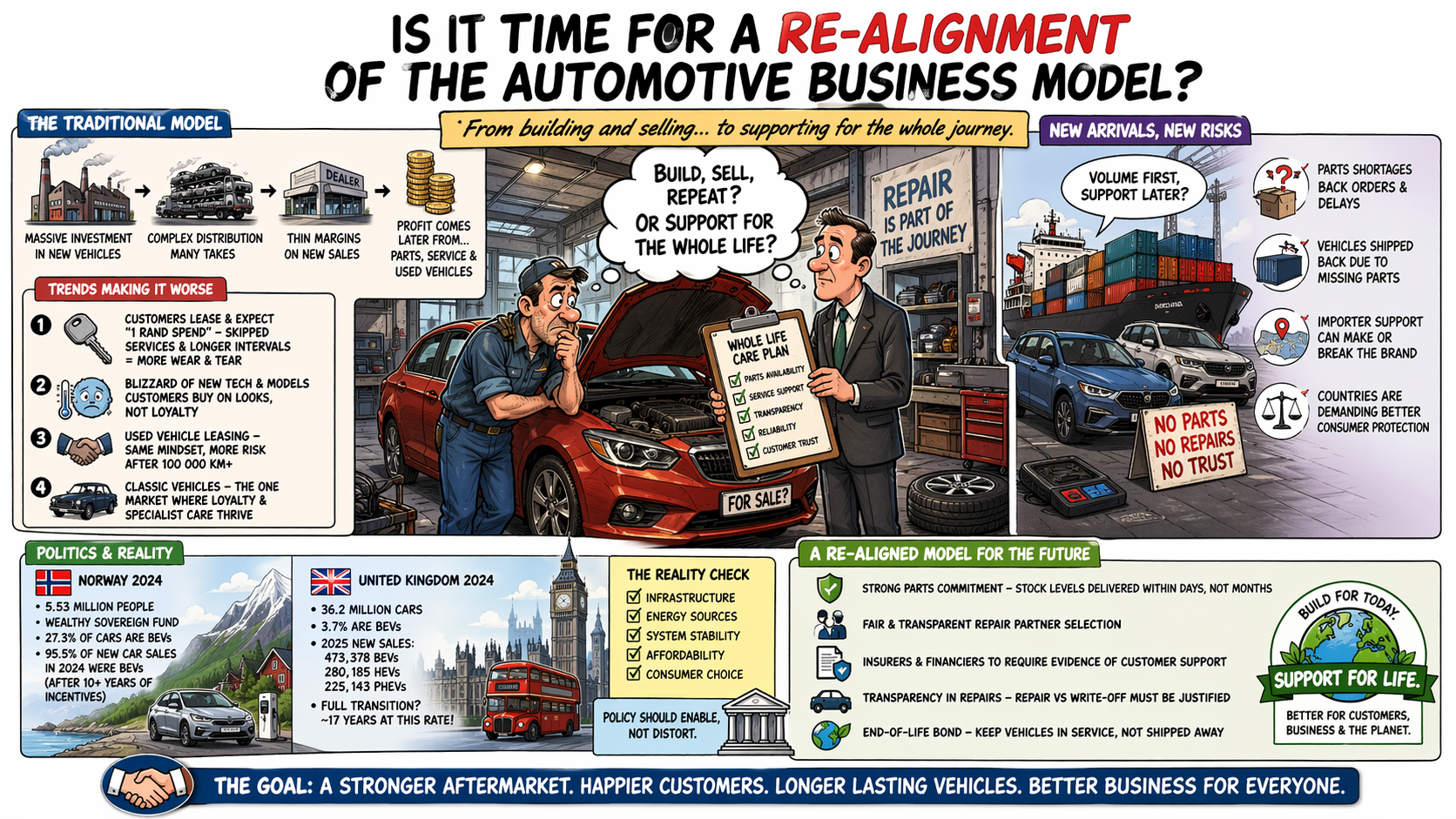
The automotive business model has changed very little since then. A vehicle manufacturer raises an immense pile of debt to invest in massive quantities of very specialist tooling, paying for an entire project to run without income for anywhere from 18 months to 7 years. Once released the vehicles are built and sold in the largest possible quantity from the investment.
The new vehicle distribution system for a long time has been hollowed out as everyone from Government to transport providers take their cut, leaving the rather fine distributor at the end of the process with very little direct profit from each sale. Instead, they rely on vehicles returning for repair / service, or retailing younger used vehicles. The latter is now the main source of profit.
For the vehicle manufacturer the main source of profit from each new vehicle sale is from replacement parts.
Several trends make the situation worse:
- Consumers of new vehicles like the idea of renting it, with a badge of honour not to spend 1 rand during their tenure on servicing. Between customers skipping routine servicing and stretched service intervals to flatter cost of ownership, the vehicles suffer.
- The blizzard of new technologies and models since 2010 has left a big slice of the new car customer ‘cold’ – they’ll literally buy a vehicle because of the shape or colour. There is a much-reduced loyalty to any vehicle manufacturer.
- The growth of used vehicle leasing, where some customers may be tempted to treat it the same way as the first lease period, which in the main most vehicles with more than 100000 km covered will not tolerate.
- One market where the traditional visits to dealers and specialists exists is for older ‘classic’ vehicles.
Political ideas
The mantra of ‘zero emission’ specifically means ‘zero tailpipe emissions’. No account is made of the material processing or energy investment required to deliver electrified powertrains. Many, many BEV fans refer to the 2025 success of cars and light vans powered by battery electric powertrains sold in Norway. That sound impressive until one realises…
- Norway had roughly the same access to oil and gas wealth from the North Sea as the UK did, but only ever had a total population of 5.53 million people. Less than half of London.
- The policy around BEV sales was driven by significant subsidies funded by the sovereign fund, which is the host for tax income from the North Sea oil and gas.
- The ‘97.6 per cent’ of new cars were registered (35,188) was the total for December 2025, ahead of significant subsidy reductions in 2026.
- The overall 179,550 new cars were registered in the Norway for the whole of 2025, of which BEVs accounted for 95.5 per cent.
Apart from Norway having the wealth to indulge in BEVs, having built up sales via incentives over more than 10 years only now in 2025 does peak rate-of-change occur. As of December 2024;
- There were 2,889,023 cars (out of 5,431,513 vehicles, which includes trailers).
- There were 788,753 BEV cars (27.3 per cent).
For comparison, here are the UK stats as of December 2024:
- The UK had 36,165,401 cars.
- 1,334,108 were BEVs (3.7 per cent).
In 2025 the UK sold 2,020,520 new cars, of which 473,378 cars were BEVs, 280,185 cars were HEV and 225,143 cars were PHEV. We can see to change 36 million vehicles of which by 2025, 1.8 million were BEVs, would take 17 years to complete the change if only new BEVs were sold.
Let’s forget where the electricity will come from.
Let’s forget the stability of BEV system design.
New arrivals
We can see selling new vehicles is tough, selling spare parts is tough and there are policy pressures in some parts of the world that have made products much more complex.
Now consider an entire nation geared up to build vehicles. China built 34.531 million vehicles in 2025, of 34.35 million were sold, including 8.32 million vehicles for export. One in three vehicles built during 2025 came from China. Of the export vehicles, 3.43 million units were BEVs.
However, there is a ruinous internal market price war which has raged for more than 3 years, leading manufacturers to recover costs by increased exports, since each export vehicle earns much more profit than on the domestic market. The whole system is geared to build vehicles, and the notion of product support – service, parts – is for many China OEMs a new concept.
Where are the parts?
Rather the position is to make sales and is anything goes wrong, replace the whole vehicle or strip parts from unsold vehicles. A few years ago, one China manufacturer failed to provide any meaningful support for UK customers, leading motor insurers to refuse underwriting. More recently another importer to the UK ended up with back orders for 18 door mirrors after just 2 months of sales, clogging up bodyshops.
One new entrant to the UK talked of 250000 items in the warehouse (anyone from a paint retailer to a parts retailer knows that is not a very big number to serve an entire country) and parcel delivery companies would take care of delivery. For those who listened to this, it was deeply unimpressive.
The lack of parts is repeated in South America, where many nations are now trying to establish rules for vehicle importer behaviour. Europe and the UK have done very little about this, so far. In Mexico, one of the main export markets for China built vehicles, as well as Brazil, there are cases of vehicles disabled by missing parts loaded into shipping containers back to China.
How can collision repairers make any sense of this?
Not all China based vehicle manufacturers are doing a bad job, since the importer – especially is not owned by the company – is a critical part of the way customers are treated.
There is also a worsening situation with reliability of vehicles even from established Japan, South Korea and European manufacturers due to rapid changes in global legislation combined with changing patterns of attitude towards vehicle repair. Some things that could change would be:
- Like a bank or an insurer, a vehicle importer would undertake to provide certain stock levels of parts within days, maximum months, of starting operations.
- Selection of repair partners – bodyshops, for example, would follow an objective and open process rather than passing by the outside of the business via a street view of a map.
- The above would be a condition of underwriting – evidence of consumer support.
- For the user, there would need to be evidence if the vehicle is on some sort of finance that they have looked after what is, in effect, a asset owned by somebody else. This would include evidence of motor insurance cover continuity, especially if it was a condition of the financial arrangement.
- For the motor insurer, there would need to be evidence that the vehicle subject to a claim for damage has been repaired – or a clearly stated calculation to justify why it was written off. This is commercially sensitive information, but then again, the person paying for the cover should expect transparency.
The objective would be to create a stronger automotive aftermarket which is more able to resist external economic pressures and retain road registered vehicles for longer.
The big message: How do all vehicle manufacturers migrate from only building new vehicles to whole life cycle care? It will not be easy, and many manufacturers are trying to do their own thing in terms of refurbishing or even rebuilding used vehicles. One idea could be to add some teeth to the end-of-life directive – a financial bond on every vehicle built or imported, payable to the Government if it is exported whole to another country.
Maybe that could help keep vehicles alive for longer, to produce more repair opportunities for all vehicles?