Why a major brand cull now looks inevitable
“This is not restructuring. It is controlled retreat.”
There is a difference between a company managing complexity and a company being consumed by it.
Right now, Stellantis is starting to look like the latter.
On paper, the group remains formidable. In the first quarter of 2026, it shipped around 1.36 million vehicles globally, up 12% year-on-year. Growth came from both North America and Europe, supported by new product launches and steady demand in key segments.
But those headline numbers hide a more uncomfortable reality. Stellantis is not one business moving in a single direction. It is a collection of brands, strategies and legacy decisions, many of which are now pulling against each other.
And increasingly, the cracks are visible.
North America: from dominance to fragmentation
To understand the scale of the issue, you need to start in North America, historically one of Stellantis’ most profitable regions.
The old Chrysler portfolio has effectively hollowed out.
- Chrysler is down to one meaningful model line
- Dodge, once a performance-led brand, is now operating with a minimal range
- Ram carries the commercial and pickup business, and is still performing
- Jeep remains the only brand with real breadth and global relevance
That is not a balanced portfolio. It is a structural imbalance.
The Jeep Wagoneer S was meant to signal the next phase, a shift into high-performance electrified SUVs that could carry the brand forward in a changing regulatory and consumer environment.
Instead, it has become a case study in mistimed strategy.
Launched in early 2025, the Wagoneer S initially showed promise, with just over 10,000 units sold in its first nine months. But momentum collapsed almost immediately afterwards. In the following six months, sales dropped to just 613 units, with only 175 units recorded in the first quarter of 2026.
Stellantis has now taken the unusual step of cancelling the 2026 model year entirely, with the vehicle expected to return as a 2027 model following revisions to battery performance, software and charging compatibility.
That is not a minor product adjustment. It is a tacit admission that the original proposition did not land.
Several factors converged at once:
- The removal of the US federal EV tax credit reduced consumer incentives overnight
- Import tariffs on vehicles built in Mexico added cost pressure
- The wider US market shifted away from early EV adoption towards hybrid and ICE stability
But these are external triggers. The underlying issue is internal.
Stellantis placed a high-cost, high-performance BEV into a market segment that was not yet ready to absorb it at scale, without sufficient insulation from policy risk or pricing volatility.
That is a strategic misread.
Europe: strength masking structural weakness
If North America shows contraction, Europe shows something more complicated, growth without control.
Stellantis remains one of the largest automotive groups in the region, and Q1 2026 shipments increased by around 12%, driven in part by new “Smart Car” platform products such as the Citroën C3, C3 Aircross, Opel/Vauxhall Frontera and Fiat Grande Panda.
These vehicles matter. They are simpler, cost-focused, and aligned with real consumer demand.
But they also highlight a deeper contradiction.
The group’s strongest performance is now concentrated in:
- Entry-level passenger vehicles
- Light commercial vehicles
The Stellantis Pro One division delivered over 408,000 commercial vehicles in Q1 alone, maintaining market leadership across multiple segments in Europe and South America.
In other words, Stellantis is performing best where:
- Products are functional
- Margins are controlled
- Complexity is limited
By contrast, several passenger brands are struggling to justify their existence.
Alfa Romeo remains low-volume and niche. DS continues to lack clear identity and scale. Lancia is effectively a single-model operation. Chrysler and Dodge have no meaningful presence in Europe at all.
Even where volumes exist, overlap is extensive. Peugeot, Citroën, Opel/Vauxhall and Fiat frequently compete in adjacent segments with shared platforms and limited differentiation.
This is not brand diversity. It is internal competition.
The China question: capacity, politics and control
The most telling development is not in product, but in manufacturing.
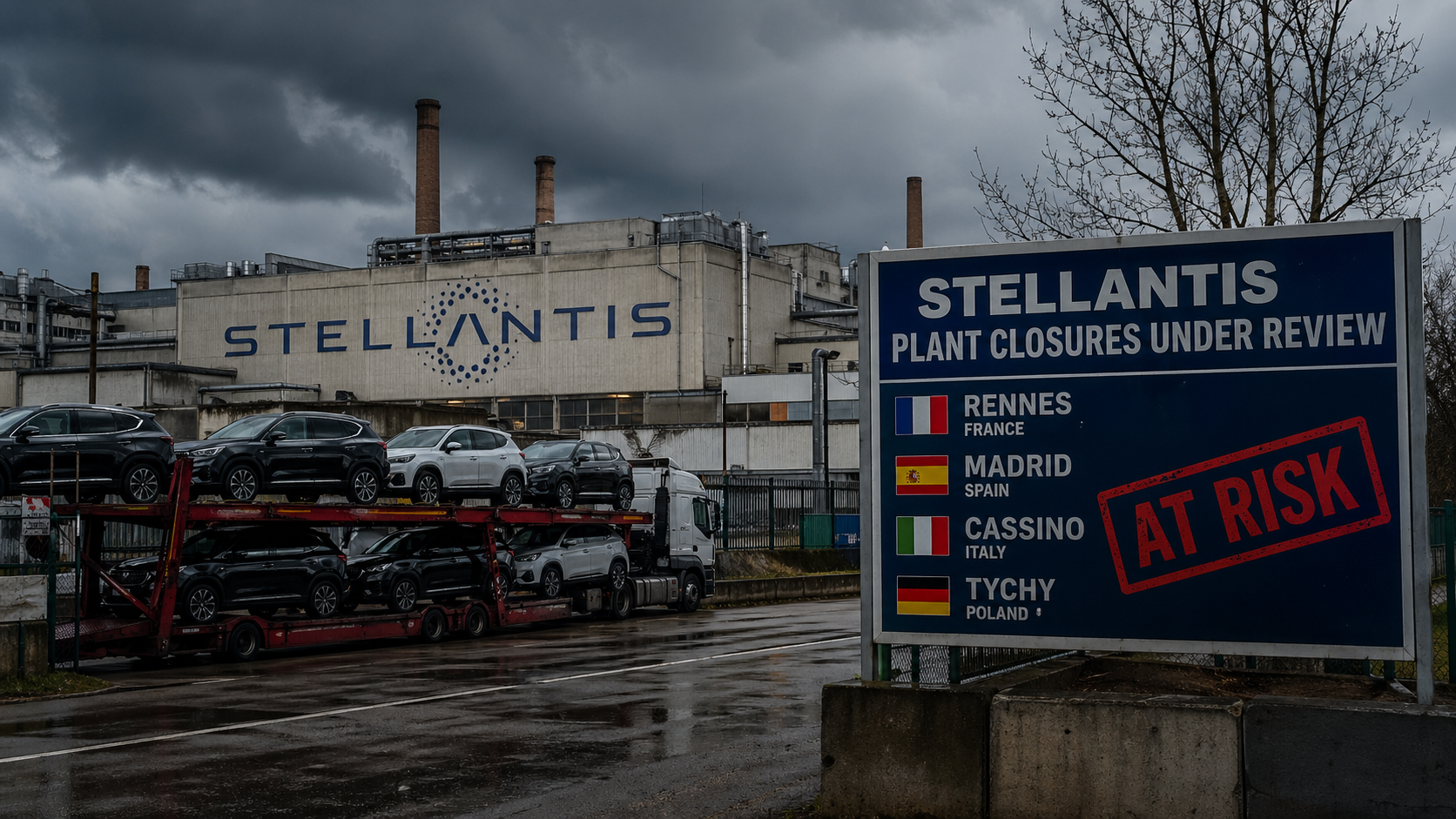
Stellantis has acknowledged that it has surplus production capacity in Europe equivalent to four plants. That is a significant overhang in a region where demand has not returned to pre-pandemic levels and where cost pressures remain high.
Closing plants outright is politically difficult, particularly in France and Italy.
So the alternative being explored is partnership.
Chinese manufacturers, including Dongfeng, have already toured multiple Stellantis sites across Europe, assessing opportunities for shared production or potential acquisition. Discussions reportedly include facilities in France, Spain, Italy and Germany.
On the surface, this is presented as collaboration.
In reality, it is a trade.
Stellantis gains:
- Reduced excess capacity
- Avoidance of politically sensitive closures
- Short-term financial relief
Chinese manufacturers gain:
- Immediate access to European production infrastructure
- Reduced exposure to import tariffs
- Insight into European manufacturing systems and standards
This is not a neutral exchange.
It accelerates the entry of already competitive Chinese OEMs into the European production base, while reducing Stellantis’ direct control over its industrial footprint.
Put simply, Stellantis is solving a short-term problem by introducing a long-term competitor into its own backyard.
The inevitable question: which brands survive?
All of this leads to a single, unavoidable conclusion.
Stellantis cannot continue to operate 14 brands with full engineering, regulatory, software and marketing support behind each one.
The cost structure alone makes that unrealistic.
The brands most exposed are those that lack one or more of the following:
- Scale
- Clear market positioning
- Strong margins
- Regional relevance
That puts Dodge, Chrysler, Alfa Romeo, Lancia and DS firmly in the firing line. Maserati, while more protected by its premium positioning, is not immune given its low volumes and high development costs.
The group’s investor day on 21 May 2026 is now expected to set out a clearer direction.
But the direction of travel is already visible.
What this means for the repair sector
For repairers, insurers and the wider aftermarket, this is not just corporate strategy. It has direct operational impact.
Brand contraction and plant restructuring create:
- Parts availability risk, particularly for low-volume models
- Disruption to technical data and repair procedures
- Residual value volatility affecting total loss thresholds
Vehicles like the Wagoneer S are particularly exposed. Low volume, high complexity, and uncertain future support create exactly the kind of risk profile that drives up repair cost and cycle time.
At the same time, increased Chinese OEM presence in Europe introduces new variables:
- Different design philosophies, which are evolving due to repair requirements which are not so developed in the domestic market
- Different parts supply chains
- Different repairability assumptions due to source market immaturity
Repair networks will need to adapt faster than the OEMs themselves.
A moment of selection
Stellantis is not collapsing. It still has scale, strong commercial vehicle performance, and successful products in key segments.
The merger that created Stellantis brought together brands, plants and strategies that made sense in isolation, but are increasingly difficult to sustain together.
What comes next is not expansion.
It is selection.
And for the first time since the group was formed, that selection is likely to be visible, structural and permanent.