In a land far away (Sweden) was a manufacturer who did things differently. One of the projects was elimination of the steering wheel, replaced by a joy stick in the centre of the dash, so avoiding matters of steering wheel airbags, steering column intrusion and so on. The same company many years later introduced a secondary diagonal belt which could, when deployed, release access to more engine performance.
The company was Saab. These were some of the innovations they sought to put into production, but neither the insurers or type approval authorities were convinced. After rejection by USA and European authorities, they tried to get the systems into production via friendly Scandinavian authorities and insurers, but one by one they declined.
The automotive business has traditionally moved at quite a slow pace, because products are some of the largest and most expensive most people buy apart from a house. In addition, it is expected to last for at least 10 years with the yield of cash if sold before then.
The vehicle design is the primary means to differentiate, and that leads to a rich seam of manufacturer model specific parts – the doors, the interior trim, the exterior trim and body panels. For some items such as control modules, they will frequently have a generic form – Robert Bosch for example, make a few ESC module cores – but are adapted to make them exactly, precisely unique for the vehicle manufacturer. Of course, the aftermarket supply industry has a gaggle of parts manufacturers ranging from the very Teir 1 suppliers to pattern part manufacturers.
Enter the electric door handle
Closures – the bonnet, doors, tailgate / rear load doors – are some of the most intensely engineered assemblies on a vehicle. They are highly visible, frequently used and have to preform additional tasks such as part of pedestrian safety (bonnet) or anti intrusion (door side impact beams). During the voluntary Euro NCAP impact test suite or the type approval test suite the doors must not unlatch, but after impact they have to open without being jammed into the body structure.
Mechanical flush door handles have been around for decades, but Tesla with the Model S in 2012 made pop out electric door handles, assisted opening and closing, standard. Over many years and with many, many revisions including out sourcing the manufacture to specialist companies, most of the issues were eliminated – manual emergency release is possible but remains something of an art on the present products. The door handles became a signature along with BEV powertrain and ADAS to ‘define’ BEV ownership.
Xiaomi, a China smart phone company in the mould of Apple, joined the car manufacture business in 2024 with much excitement for the first product, SU7, with assembly by BAIC. In a matter of months great excitement turned to anger. The doors did not always work after many impact scenarios, leaving occupants trapped, and in the case of fires, death. Other China domestic manufacturers applying the ‘Tesla’ look fell into the same trap, but Xiaomi became embroiled in legal actions more than any other company. With tensions rising, something had to be done.
USA and Europe discuss – China acts
The European and USA authorities have long worried about the performance of electric powered door latches in the event of impact. However, no law appeared.
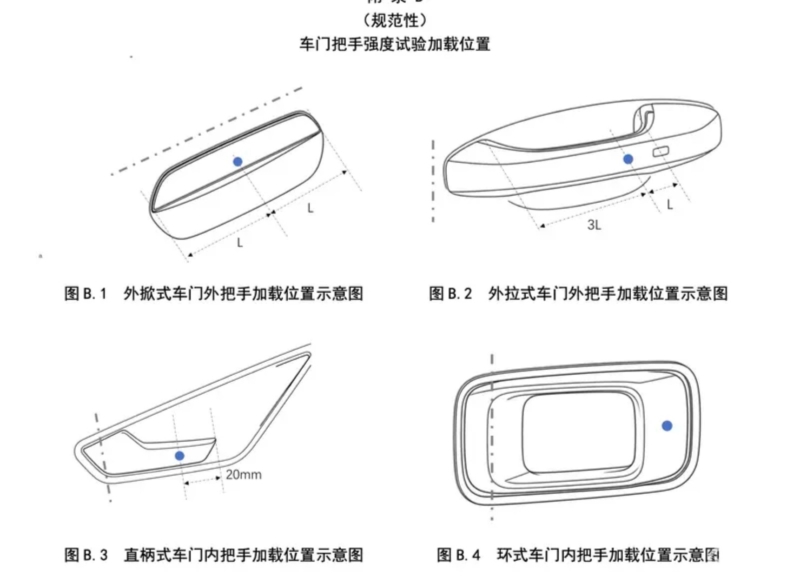
The China Ministry of Industry and Information Technology (‘MIIT’), faced with growing consumer anger, put together a team who did extensive bench marking which then came up with a design standard of interior and exterior handles – the form, the location, peak loads and the requirement for default mechanical operation. The new domestic type approval standard GB 48001-2026 was issued by MIIT on 28th January 2026, applies to all newly introduced models from 1st January 2027, and all existing production vehicles by 1st January 2029.
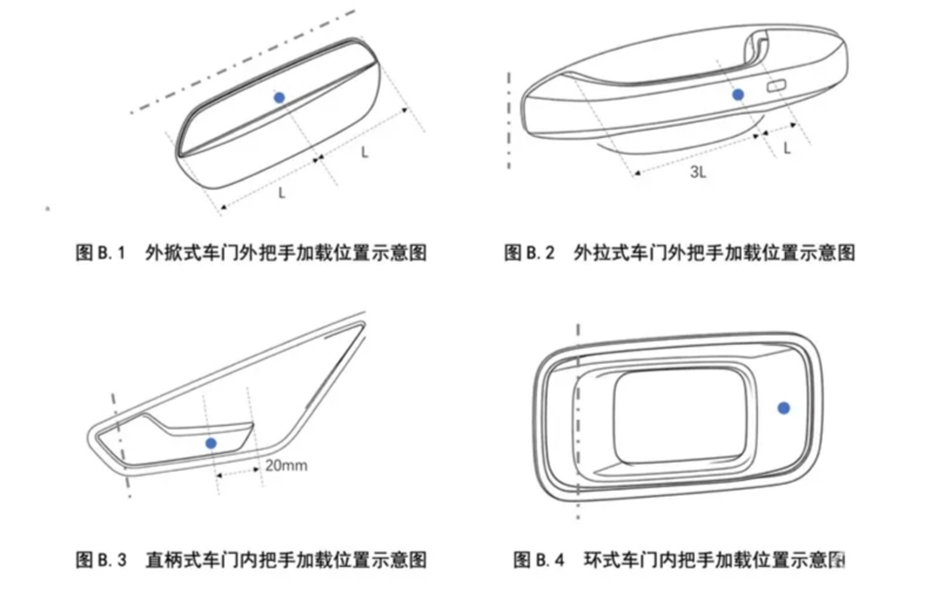


The standard requires every door and tailgate must be possible to open mechanically even after electric system failure or impact, a minimum handle grip zone of 60mm × 20mm × 25mm and withstand a minimum of 500N force without handle fracture or failure. In addition the internal door handles should be placed 680mm above the seat R-point as well as have a marking visible even at night.
Why be aware? Most vehicle manufacturers are unlikely to build specific doors for China, so these solutions will find their way to Europe. And the reason for that? China is the biggest automotive market in the world.
On a roll
China, emboldened by this type approval law, have decided to address other areas of concern:
- Central touch screens, looking to force key functions such as heating and ventilation to be controlled via switches – so curbing the functionality of the display. This is seen as a way to reduce driver distraction.
- Steering wheels with just two spokes and no rim, typically used on steer by wire systems. The first versions are able to vary the angle of the steered road wheels. For parking they could move through nearly full lock, yet at high speed the movement would be smaller. The user has to adapt to the same angular displacement of the steering wheel achieving different results depending on the speed.
- Driver monitoring (a mandated feature in Europe already). Driving skills are not always to a high standard in China, and in major cities traffic jams are a way of life – so some drivers think the vehicle with little more than SAE Level 2 ADAS can allow them to go to sleep… at the wheel. This is set to be addressed in law aimed at enforcing proper use of the vehicle and standardisation of how the systems perform.
So, China goes from patchy standards to the intention to dominate the global type approval starting with door handles. Given the cost of tooling, size of the domestic market and annual manufacturing capability (circa 25 million units) it is possible China just might succeed.
Uniform tests. Uniform product. Somehow that grates. Fancy a joy stick? Maybe not….