The automotive business model has changed very little since the late 1890s. A vehicle manufacturer raises an immense pile of debt to invest in massive quantities of very specialist tooling, paying for an entire project to run without income for anywhere from 18 months to 7 years. Once released the vehicles are built and sold in the largest possible quantity from the investment.
Political ideas
Many, many BEV fans refer to the 2025 success of cars and light vans powered by battery electric powertrains sold in Norway. That sound impressive until one realises…
- Norway had roughly the same access to oil and gas wealth from the North Sea as the UK did, but only ever had a total population of 5.53 million people – less than half the population of London.
- The policy around BEV sales was driven by significant subsidies funded by the sovereign fund, which is the host for tax income from the North Sea oil and gas. The UK had the same scale of income for 58 million rising now to 70 million people.
- The ‘97.6 per cent’ of new cars were registered (35,188) was the total for December 2025, ahead of significant subsidy reductions in 2026.
- The overall 179,550 new cars were registered in the Norway for the whole of 2025, of which BEVs accounted for 95.5 per cent.
Apart from Norway having the wealth to indulge in BEVs, having built up sales via incentives over more than 10 years only now in 2025 does peak rate-of-change occur. As of December 2024;
- There were 2,889,023 cars (out of 5,431,513 vehicles, which includes trailers).
- There were 788,753 BEV cars (27.3 per cent).
For comparison, here the numbers for the UK as of December 2024:
- The UK had 36,165,401 cars.
- 1,334,108 were BEVs (3.7 per cent).
In 2025 the UK sold 2,020,520 new cars, of which:
- 473,378 cars were BEVs,
- 280,185 cars were HEVs,
- 225,143 cars were PHEVs.
- 937,938 cars were petrol engine powered.
- 103,906 cars were diesel engine powered.

We can see to change 36 million vehicles of which by 2025, 1.8 million were BEVs, would take 17 years to complete the change if only new BEVs were sold.
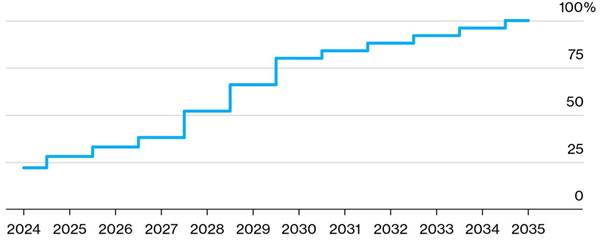
DfT mandated BEV car sales per year. A complex arrangement of BEV credits meant manufacturers could pay a very high price for under or over achieving the set target, or trade with other manufacturers. By 2025 the 28 per cent target was not met – 23.8 per cent was deemed ‘unsustainable’ by the SMMT.
Mixed market economy
The reality is even if the DfT ‘staircase’ to demand 70 per cent of all new cars will be BEVs by 2030 is not achieved – it won’t be – there is a viable BEV marketplace running at circa 22 per cent with incentives or closer to 15 per cent without. Further, the much-troubled PHEV is about to be re-born as a Range Extender EV, where an on-board internal combustion engine will have limited to zero direct mechanical drive, but instead provide electricity on demand.
Then there’s the alternative battery chemistries, and even alternative constructions. For instance, Sodium-ion weighs about 50 per cent more than any Lithium-ion configuration, but is relatively stable and costs around $58 per kWh – the cheapest Lithium-ion sources cost more around $75 per kWh, and the highest performance Lithium-ion creations (latest cathode and anode materials as well as most adventurous electrolyte) can cost $200 to $300 per kWh. Options such as Sodium-ion potentially open up smaller, more cost critical applications whereas the very latest chemistries, the very best battery energy storage density, will appear on more expensive vehicles.
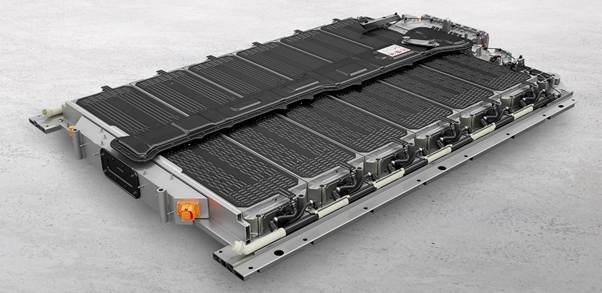
Porche Cayenne BEV for 2026 uses the Volkswagen Group PPE platform. The 800V architecture features a 113 kWh lithium-ion battery with 96 cell pouches fitted inside 6 modules. The anode is made from graphite-silicon and the cathode is made from nickel-manganese-cobalt-aluminium; there is 86 per cent nickel.
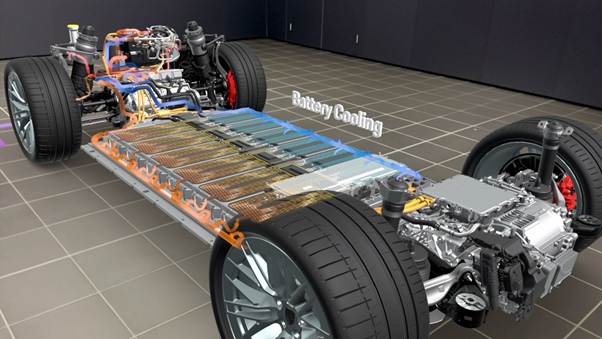
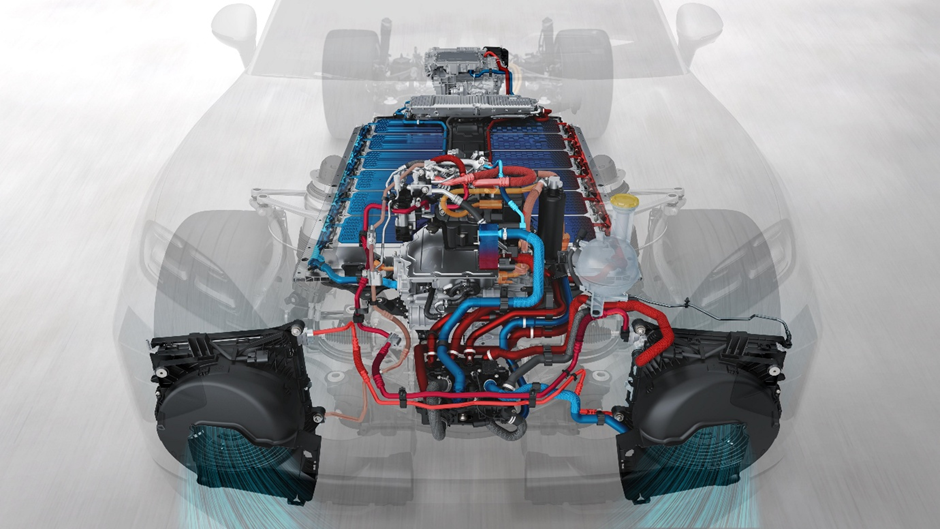
Porche Cayenne BEV for 2026 battery cooling system has manifolds running the length of pack. There are heat transfer plates above and below the cells – usually they are only on the lower face. This is done to flatter the recharge rate and to help manage optimal battery cell temperature during operation.
Add into the mix the growing pains of brining a brand-new industrial process to commercial scale, and we get the ‘solid state’ battery. Although there is a race between Sony (with Honda) and at least two China manufacturers to be first to market, the appearance is often announced and rarely delivered. Work in progress.
So, one way or another, batteries will be with us for some time. The prevailing ‘fashion’ (pouches to cells, modules to direct integration) / cost pressures / latest developments will happen year by year….
The vehicle in use
For the largest traction batteries found on BEVs, the underside of the pack is frequently on the ground clearance line. Even if the battery is protected by the body from impact damage, secondary damage can occur as the vehicle with the driver as a passenger, skids to a rest.
Right now, there is no standardised or easy way to quickly establish:
- Is the traction battery cooling system intact, including the heat transfer plates inside the pack?
- Is the battery control module, which takes at least one internal thermocouple input along with monitoring energy flow across clusters of cells / pouches (so, not cell level monitoring) controlling the cooling system?
- What is the scale of the damage to the case, and what is the allowable deformation before internal damage become catastrophic?
Cells buried deep inside the battery
Here’s a tale from Geely to illustrate the above problem does not only exist for collision.
Geely have a traction battery assembly subsidiary Viridi E-Mobility Technology (‘Vremt’), who allege cells supplied by Sunwoda EVB between Jume 2021 and December 2023 were defective. These were built into various vehicles for the Zeekr brand and sold in China. Geely Group are suing for around $323 million as of December 2025. In this case Sunwoda EVB owned 30 per cent of the Vremt joint venture with Geely.
Geely claims that the affected battery cells supplied by Sunwoda had “serious quality defects” including allegedly led to slower charging speeds, inaccurate range displays, and abnormal battery capacity degradation in several Geely-affiliated brands. The claim amount nearly equals Sunwoda’s total net profit for the previous two years (2023–2024).
At this very time Volvo Car (a Geely owned company) announced the EX60 reveal, which is one of their most important new cars ever.
As this was happening, in December 2025, Volvo Car initiated a series of actions leading to a notice for the 33,777 EX30 vehicles worldwide, including 10,440 in the UK. The EX30 is built in China on the Geely SEA2 platform. The alleged defective cells can build up lithium deposits inside the cells which in 0.02 per cent of all units, eventually shorts and can induce thermal runaway.
The suspect cells were made between 6th September and 25th October 2025, and were involved in an incident in Brazil which severely damaged a dealership. Remember, just 0.02 per cent cells were suspect out of 33,777 cars
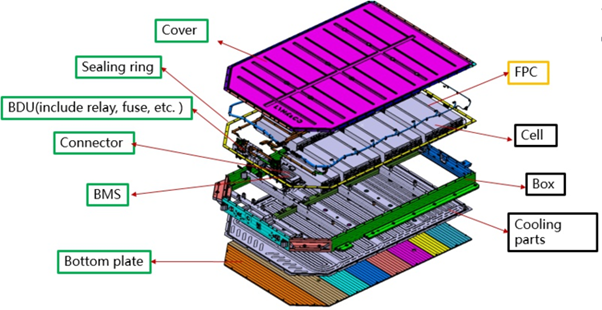
This is the Geely SEA2 platform battery pack as used by Volvo EX30. A defect inside the battery can be difficult to quantify, and there are still not enough businesses prepared or able to strip down the pack. During impact damage can occur in the internal cooling system or in the cell sub-packs, remembering this underneath the entire passenger cell floor and is the lowest point on the vehicle.
This time the Geely traction battery assembly subsidiary Vremt was supplied with cells from several companies including….. Sunwoda EVB. The supplier counter claimed stating the pack construction, cooling strategy and BMS were all the property of Vremt, so the fault was not theirs.
The advice was:
- Do not park in closed spaces or under cover.
- Do not charge more than 70 per cent of maximum.
Not all of the cells made during this period are defective, but a few are not in balance with the rest inside a given pack. As each of the imbalanced cells is exposed to in effect over charging, the problem can occur. The defective cells were also used to build battery packs for Zeekr 001, Zeekr X and smart #3, although these affected vehicles seem to have been only sold in China.
The big questions
The story above shows the practical limits to triage of a BEV with suspected battery damage. We can see the battery cell supplier (7th largest in China) made a critical part which relied on quality assembly and well-designed thermal management systems to work. Due to the ‘averaged’ cell performance monitoring, it is essential to have all cells performing in the same way.
When a problem is raised, the ‘old’ route of simply replacing the entire pack raises issues around handling damaged battery packs (special packaging requirements and officially hazardous waste) as well as the logistics of shipping assemblies weighing anywhere from 200 to 700 kg.
ln turn, using the full retail price of the battery knowing a BEV without a battery is in effect scrap, is likely to end up as salvage. A more interesting route is to repair the battery, which of course requires removal, opening it up and investigating the internals.
A point long discussed here is the very valuation and write-off thresholds used by motor insurance companies. Given this is a hugely valuable business, change may only be possible with the influence of policy, to ensure more vehicles remain on the road for longer. Perhaps damage assessment of BEV batteries and routing them through specialists for refurbishment is the start of that process.