The UK collision repair industry used to be built around local reputation.
A family-owned bodyshop might spend thirty years building relationships with insurers, dealerships and fleet operators within a single town or county. Customers knew the owner by name. Technicians stayed for decades. Expansion often meant opening a second site twenty miles away, not rolling up half a region under a central operating structure.
That version of the market is disappearing.
The collision sector is now moving through one of the biggest structural shifts in its modern history as consolidation accelerates across the UK. Large multi-site operators continue expanding aggressively, insurer influence keeps growing and private investment money is reshaping the economics of repair networks from the ground up.
Groups like Precision Repair Group sit directly inside that transition.
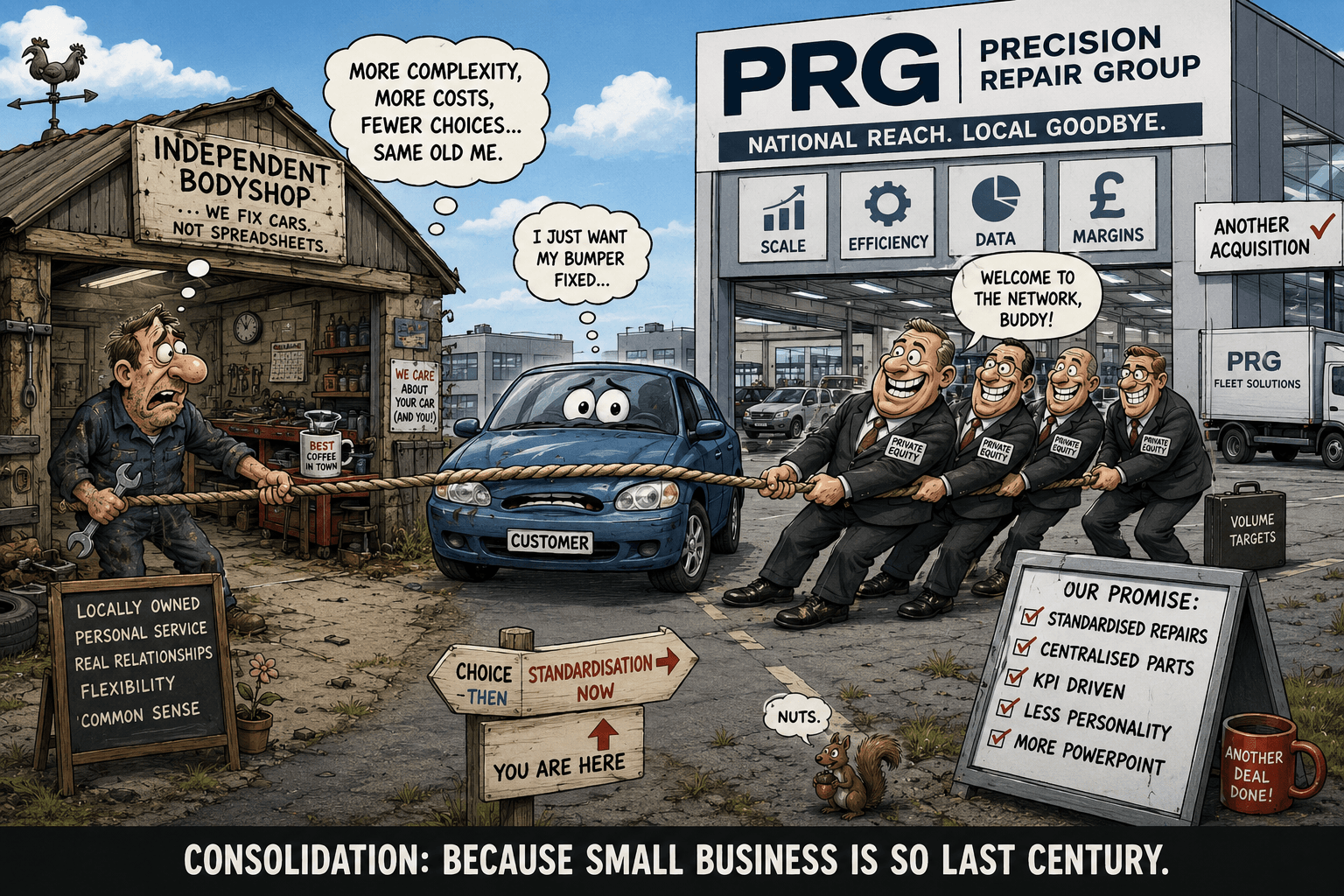
For some repairers, these emerging national operators represent the future of a modern, scalable repair industry. For others, they represent the slow erosion of independence, local flexibility and workshop identity.
Either way, the direction of travel is becoming difficult to ignore.
The conditions driving consolidation did not appear overnight. The economics of collision repair have been tightening for years. Repair complexity climbed steadily as ADAS systems spread across mainstream vehicles. EV adoption introduced high-voltage safety requirements, battery handling procedures and new tooling demands. Aluminium and mixed-material repair processes pushed equipment costs higher again.
Then came inflation.
Paint materials rose sharply. Energy prices surged. Labour shortages intensified. Vehicle cycle times stretched under parts delays and calibration requirements. Meanwhile insurers continued pushing hard on repair rates and operational performance metrics.
For many smaller operators, the pressure became relentless.
That environment heavily favours scale.
A large repair group can spread investment costs across multiple sites. It can spread the calibration operation investments across more sites, negotiate stronger parts agreements and move work dynamically around regional capacity. It can justify dedicated EV repair hubs, specialist aluminium centres and internal training academies because the volume exists to support them.
An independent repairer often cannot.
That imbalance is one reason groups like Precision Repair Group have expanded so aggressively into fleet and mainstream repair channels. Fleet work in particular has become strategically important because it offers volume consistency and commercial leverage at a time when insurer-controlled repair economics remain increasingly volatile.
The fleet market itself has changed dramatically over the past decade. Large corporate operators now demand near-national coverage, standardised reporting, digital integration and tightly controlled downtime performance. A fragmented network of disconnected independents struggles to meet those expectations consistently.
National groups can.
That reality explains why insurers and fleet operators increasingly favour larger consolidated repair networks. Procurement teams want predictable KPIs, shared operating standards and simplified account management structures. One contract covering dozens of locations is operationally easier than managing hundreds of individual repairers.
The collision industry is becoming corporate.
Walk through a modern consolidated repair group and the differences become obvious immediately. Processes are tightly structured. KPI dashboards track everything from key-to-key cycle times to calibration completion rates and parts ordering performance. Training programmes are standardised across sites. Tooling strategies are centrally managed. Repair methodologies are aligned with insurer and OEM requirements across the network.
Some independents privately admit they cannot compete with that level of operational infrastructure.
Still, consolidation creates its own tensions.
One of the biggest concerns inside the sector revolves around margin pressure. Scale gives large operators stronger negotiating power with insurers, but it also creates pressure for volume-driven operating models where efficiency dominates decision-making. Critics worry repair quality risks becoming secondary to throughput targets and commercial metrics.
That criticism is not entirely new. The collision sector has argued for years about the balance between repair quality, profitability and insurer control. Consolidation simply magnifies those concerns.
There is also the question of autonomy.
Independent repairers traditionally retained flexibility around staffing, repair methods, local customer relationships and operational culture. Larger groups often centralise those decisions. Standardisation improves consistency but can reduce local discretion. Some repairers thrive inside that environment. Others find it restrictive.
Technicians notice the difference as well.
Consolidated groups increasingly behave like major industrial employers rather than traditional workshops. Career progression pathways are clearer. Training investment tends to be stronger. Internal mobility between sites becomes possible. EV and ADAS upskilling programmes are easier to justify at scale.
At the same time, some technicians complain larger groups feel less personal and more production-driven than traditional independents.
That tension reflects a wider identity crisis inside the industry itself.
Collision repair historically operated as a craft-led trade built around local expertise and technical judgement. The modern market increasingly behaves like a managed logistics and engineering operation driven by data, insurer integration and operational efficiency.
Both models now coexist uneasily.
The challenge for independents is deciding where they fit next.
Some smaller operators are choosing specialisation over scale. Rather than competing directly with national groups, they focus on niches where agility and reputation still matter. Prestige repair, EV expertise, classic restoration, performance vehicle work and local dealer partnerships remain areas where independents can still differentiate themselves effectively.
Others are joining networks or strategic partnerships to gain buying power and insurer access without fully surrendering ownership.
There is also growing interest in collaborative tooling and training arrangements between independent businesses. Several regional repairers now share calibration capability, EV equipment and technical support resources because standalone investment costs have become increasingly difficult to justify individually.
Still, market gravity continues favouring larger operators.
The financial side matters too. Private equity and investment-backed groups increasingly view collision repair as an attractive long-term consolidation market. The logic is straightforward. Vehicle complexity keeps rising. Repair capability requirements become harder to replicate cheaply. Entry barriers grow higher every year.
That combination creates defensible scale advantages.
The next five years could reshape the industry further than many operators expect.
Several trends already appear likely. More regional independents will sell into larger groups. Fleet and insurer influence over repair processes will continue strengthening. Centralised calibration and EV repair hubs will become increasingly common. Data reporting expectations will intensify. Parts procurement power will concentrate further among larger operators.
For consumers, the outcome remains uncertain.
Large groups can deliver investment, consistency and technical capability that smaller operators may struggle to maintain independently. Yet consolidation also risks reducing competition and narrowing local choice over time.
For the repair industry itself, the bigger question is cultural.
Can collision repair retain the technical craftsmanship and customer trust that built the sector while evolving into a far more industrialised, corporate operating model?
That question sits underneath every acquisition, every network expansion and every independent repairer currently deciding what survival looks like in the modern market.
Because this is no longer just a story about growth.
It is a story about who ultimately controls the future shape of UK collision repair.