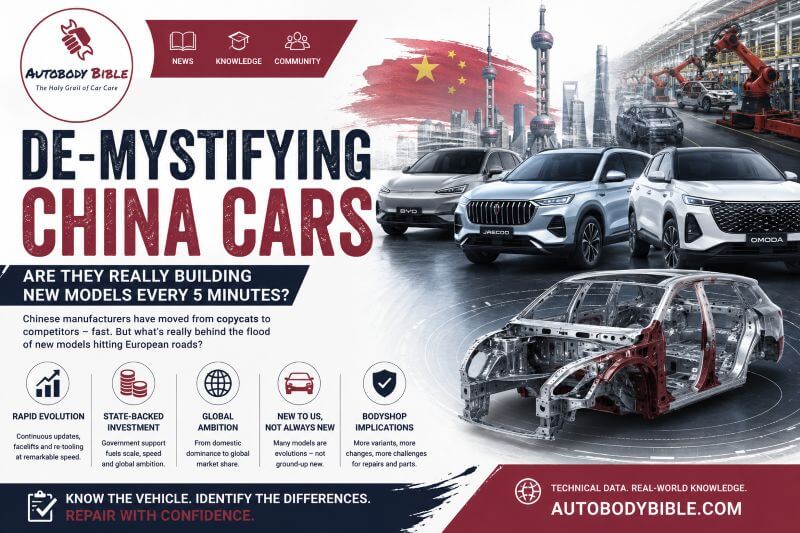
Are they really building new models every five minutes?
The automotive industry model established in the late 1800s centred on customers buying the latest and greatest product. As markets expanded, prices fell and the investment required to develop new vehicles increased.
Every major vehicle manufacturer followed this path.
The United States revolutionised mass production. Japan delivered lower-cost vehicles with better reliability. South Korea repeated much of Japan’s success.
Manufacturers perfected vehicles for their domestic markets, expanded into neighbouring countries and then targeted the most profitable regions, Europe and North America.
European manufacturers developed their own position. They served a large regional market and built an impressive international following based on consumer-perceived value.
All that glitters
More than 40 years ago, China began working towards one of its biggest industrial ambitions, domination of the global automotive sector.
The route included:
- Investment from central government and state-owned banks
- Investment from provincial governments and regional banks
- Joint ventures with overseas manufacturers, including Volkswagen, BMW, Mercedes-Benz, Fiat, Toyota, Suzuki, Mitsubishi and Honda
- Domestic production of high-volume vehicles for international manufacturers, providing access to valuable manufacturing knowledge
- The purchase of complete production lines and tooling for outgoing European models, including equipment sold by companies such as Fiat and Peugeot
- The recruitment of European and North American designers to create new bodies for domestic vehicles
- The integration of Chinese expertise in connectivity, electrification, batteries and consumer electronics
This happened as China positioned itself to dominate lithium-ion battery production. It followed a similar route in handheld computing and mobile phone manufacturing, using international partnerships before building domestic capability and scale.
The resulting wealth fed further automotive investment, but performance remained patchy. Many strategies failed to produce vehicles capable of competing in global markets.
For years, resistance to Chinese vehicles came from their reputation for average or poor quality. At the same time, Chinese household incomes rose and millions of consumers gained the opportunity to own a car for the first time.
The domestic market expanded at huge speed.
Chinese customers followed international vehicle launches online and became less willing to accept dated designs, poor build quality and vehicles based on discarded overseas technology.
Established manufacturers viewed China as the last great global market. The Chinese government saw a different opportunity. It wanted domestic companies to absorb overseas expertise, build their own products and compete internationally.
One company fails, another gains
Qoros provides a useful example.
In 2007, a small group of engineers, including former Saab personnel, helped Chery establish a 50:50 joint venture with Israel-based Quantum LLC and Kenon Holdings.
The first vehicle, the Qoros 3, appeared in 2013. It sat above Chery’s Riich sub-brand in the Chinese market.
Initial reaction was positive, but sales remained weak. The car still delivered something China wanted, European-style body engineering using multiple grades of steel.
The second model, the Qoros 5 SUV, arrived in 2015. Sales improved but did not generate enough money to fund international expansion.
Baoneng Group joined the business in 2018 and invested heavily. It ran short of cash by 2021, one year after the Qoros 7 had launched. Chery later took control of the joint venture.
The commercial venture struggled, but its engineering knowledge did not disappear.
During the same period, Chery expanded its own SUV range. The Tiggo 4 arrived in 2017, received a new body design in 2022 and remained in production until its planned replacement in 2026.
The Tiggo 7 and Tiggo 8 followed in 2020, with updates in 2023 and 2025. These vehicles share body engineering and powertrain technology with models including the Omoda 5 and Jaecoo J7.
The same pattern appears elsewhere.
SAIC benefited from acquiring MG Rover assets. Geely gained access to major engineering capability through Volvo and later cooperation with Renault.
A struggling brand can disappear. Its engineering, tooling, platforms and production knowledge remain valuable.
Continuous retooling
Every Chinese vehicle manufacturer requires a state licence to produce vehicles. No licence means no vehicle production.
State-backed finance has supported rapid expansion and helped feed China’s growing domestic car market. Many manufacturers have not developed through conventional self-funded growth.
Product updates also happen at a pace European repairers are not used to seeing.
A Chinese vehicle facelift can involve far more than new lamps, bumpers and trim. It may include:
- A revised floor structure for a battery-electric derivative
- Changes to accommodate new restraint systems
- Altered castings or pressings
- New battery packaging
- Different suspension mounting points
- Revised plastic components
- Changes designed to separate one brand from another using the same underlying engineering
The speed of retooling is remarkable. Pressings, castings, mouldings and electronic systems can change during a model’s life with limited warning.
This product uniformity has even attracted criticism from President Xi Jinping, who has challenged manufacturers over duplication and destructive competition.
The vehicles arriving in Europe are not always newly developed. Many are simply new to us.
Chinese consumers began studying overseas cars online years ago. European consumers and repairers are now doing the same with Chinese products.
Some claimed innovation is exaggerated. The connection between vehicle manufacturing, battery production, mobile software and consumer electronics is not.
An invasion?
Europe has become China’s first major international export market.
A large number of brands and models have arrived in little more than 18 months. The effect is similar to every model developed by BMW Group, Mercedes-Benz, Stellantis and Volkswagen Group during the past decade appearing in showrooms at the same time.
The commercial motive is direct.
Chinese manufacturers want market share. Vehicles sold in Europe can also deliver stronger margins than vehicles produced within Europe.
An 11 per cent share of the European new-car market could grow quickly.
That expansion carries risks.
Continuous product changes create questions around investment return, parts support, repair information and residual values. They also make it harder to support a vehicle throughout a ten-year working life.
For body repairers, a familiar model name may hide significant structural differences between production dates, trim levels and powertrain versions.
A facelift may require different joining methods. A battery version may use a revised floor. A replacement panel may not match an earlier vehicle carrying the same badge.
Repairers must identify the exact vehicle before estimating, ordering parts or beginning structural work.
Chinese manufacturers have achieved extraordinary speed and scale. That does not mean every brand, model or technical strategy will survive.
Game, set and match?
Not yet.
Competition is healthy. The repair sector now needs accurate technical data, stronger parts identification and a much better understanding of what sits beneath each new badge.