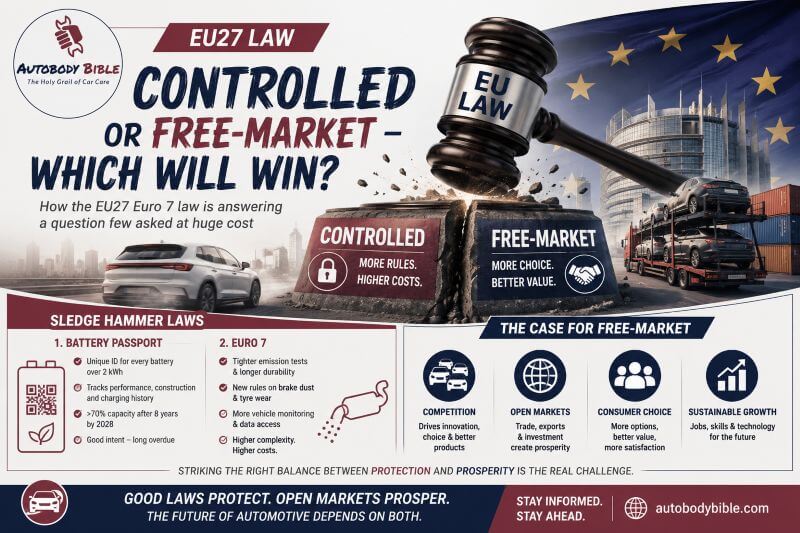
The question was direct. Would the European Commission relax type-approval rules, particularly for lower-cost vehicles, to help manufacturers protect margins and keep new cars affordable? The answer was no.
Vehicle manufacturers across Europe, South Korea, Japan and the United States share one concern: a controlled market, reinforced by punitive taxation and regulatory cost, damages trade. Modern vehicles rely on components sourced across several countries and are sold into markets far beyond their point of assembly. Restrictive trade practices invite retaliation. The EU27 and the United Kingdom need to remain accessible to manufacturers and importers, even when other markets apply a different standard.
The automotive business also needs competition. Pressure from rival manufacturers drives design, engineering and manufacturing forward. Remove that pressure and cost rises, choice narrows and technical progress slows.
The European Commission proposes legislation, drawing on input from the 27 member states. The Council and European Parliament then amend, debate and adopt it. Vehicle manufacturers, suppliers, trade bodies and campaign groups lobby throughout the process. The United Kingdom is no longer an EU member, but it still aligns with much European vehicle legislation because manufacturers have little appetite for engineering separate parts and systems for one medium-sized market.
European administration has its own theatre. Parliament works in Brussels and Strasbourg. Treaty obligations still require the regular movement of people, equipment and documents between the two cities. It is an expensive symbol of how political compromise can survive long after technology has removed the practical need.
Sledgehammer one: the battery passport
Nissan launched the Leaf in 2010 and placed one of the first modern mass-market battery electric vehicles into customers’ hands. Renault followed with the Zoe. The achievement was substantial. The engineering decisions behind the early battery systems created a different legacy.
Early Leaf models relied on passive battery temperature management. The pack lacked active liquid cooling and heating. That decision exposed the battery to accelerated degradation in demanding climates. Nissan revised the battery several times during the first generation as field experience exposed the limits of a system designed around a narrower operating environment.
The Zoe created its own complications. Renault sold the vehicle but, in many markets, leased the traction battery under a separate agreement. That split caused practical problems for owners, repairers, insurers and salvage operators. One vehicle had two financial interests attached to it, with the most expensive component controlled under a separate contract.
Tesla took another route with the Model S. It used active thermal management and treated the battery as an integral part of the vehicle purchase or lease. Most manufacturers followed that structure.
The EU battery passport now tries to impose the traceability that the market lacked during the first wave of mass-market electric vehicles. Under Regulation (EU) 2023/1542, electric-vehicle batteries, light means of transport batteries and rechargeable industrial batteries above 2 kWh must carry a digital battery passport from 18 February 2027.
The passport links a specific battery to data covering composition, carbon footprint, recycled content, performance, durability, repair, dismantling and end-of-life handling. Access levels vary, but the basic principle is sound: a battery should retain an identity throughout its working life.
That is legislation the market needed before the first Leaf arrived, not 17 years later. Better late than never.
The battery passport must not be confused with Euro 7 battery durability requirements. Euro 7 sets minimum in-vehicle battery performance for electric cars and vans. The regulation requires at least 80 per cent of original capacity after five years or 100,000 km, followed by at least 72 per cent after eight years or 160,000 km. Most competent modern battery systems already work close to, or beyond, those levels.
China moved faster on end-of-life control. New rules effective from 1 April 2026 assign a digital identity to each new-energy vehicle traction battery and place stronger recycling and traceability duties across the supply chain. The Chinese system concentrates on control, recovery and recycling. The EU system asks for a wider body of environmental, sourcing and lifecycle data.
China’s approach is already active. Europe’s battery passport begins in 2027. The difference matters because battery identification only creates value when repairers, dismantlers, insurers, recyclers and regulators can use the information.
Sledgehammer two: Euro 7
The progression from Euro 1 to Euro 4 produced major reductions in regulated exhaust pollutants. Euro 5 exposed weaknesses in drafting and enforcement. Euro 6 then became entangled with dieselgate, repeated revisions, real-driving emissions tests and a collapse in trust between legislators and manufacturers.
Euro 7 applies one regulatory structure across cars, vans, lorries and buses, though the detailed limits and test requirements differ by vehicle category. For cars and vans, the final law retained the Euro 6 exhaust limits for most pollutants. The change sits in the test conditions, monitoring, durability and the addition of non-exhaust emissions.
Emission-control durability for light vehicles extends to 10 years or 200,000 km. Particle-number measurement moves down to 10 nm, capturing smaller particles than the previous 23 nm threshold. Cars and vans also face new requirements for brake-particle emissions and tyre abrasion.
Brake dust can be measured. Brake suppliers and vehicle manufacturers have already developed test methods, low-wear materials and collection systems. Regenerative braking also reduces friction-brake use on many electrified vehicles, though vehicle mass and corrosion can complicate the result.
Tyre abrasion is harder. Wear changes with tyre compound, vehicle mass, alignment, road surface, temperature, driving style and inflation pressure. The law establishes the requirement, but technical limits and test methods depend heavily on United Nations work through UNECE WP.29. Calling it a world first does not solve the measurement problem.
Euro 7 also expands on-board monitoring. Vehicles with tailpipe emissions will record excess nitrogen oxide and particulate emissions. Data can be accessed through the diagnostic port and, in anonymised form, transmitted over the air. Anti-tampering and inducement systems will place greater pressure on owners to repair emission-control faults.
The regulation does not simply hand Brussels unrestricted access to every vehicle function, and the final Euro 7 text does not impose a universal 2,400 km no-restart rule for every emission fault. Those claims overstate the law. The real concern remains substantial: connected monitoring, emissions data and anti-tampering controls will increase diagnostic complexity and can affect vehicle use when systems detect non-compliance.
Dieselgate explains much of this. Several manufacturers manipulated emission-control strategies and damaged trust across the industry. Legislators responded with broader monitoring and longer durability obligations. A sharper enforcement regime, backed by skilled engineers conducting unannounced inspection and market surveillance, might have delivered a cleaner result than another dense layer of law.
Non-European manufacturing
China has read the European position correctly. It knows that battery traceability and recycling rules can support domestic material recovery while giving exported vehicles a stronger compliance story.
A harder question follows. Could manufacturers use short product cycles, aggressive export pricing and controlled return channels to keep older vehicles away from European dismantling and repair markets? A vehicle might be sold new, refreshed after a few years and exported again before it reaches the end of its warranty. The model would protect material recovery at home and limit the independent aftermarket abroad.
Some European aftermarket suppliers already hesitate to develop repair kits for Chinese electric drive units. Model cycles move quickly, designs change and the installed vehicle population remains fragmented. That position will change if Chinese brands approach a substantial share of European new-vehicle sales. The technical and commercial risk will then move from vehicle manufacturers into bodyshops, mechanical repairers, insurers, salvage businesses and parts distributors.
The collision repair sector needs access to battery identity, high-voltage isolation data, structural repair methods, calibration procedures, software support and replacement parts. A passport that documents a battery but does not support safe repair has missed the point.
Committees can lose sight of the vehicle
The West should not copy China’s party-state model. It should, however, learn the value of long-term industrial planning. Western governments spend heavily on visible projects, then neglect the supply chains, energy costs, repair capacity and technical skills needed to make those projects work.
Collision repairers and motor insurers face a serious risk if vehicles can enter a market freely, pay the required duties, then leave the local repair and recycling economy before independent businesses recover value from them. The balance currently favours global manufacturing over local maintenance, repair and material recovery.
The competing models are now visible. One produces vehicles designed for a 15-year service life, followed by refurbishment and another decade of use. The other replaces vehicles every few years and sends much of the associated engineering, repair and recovery work overseas.
Shipping a repairable vehicle between continents to control its residual value wastes energy and removes work from the destination market. Repairing it where it is used makes better economic and environmental sense.
Regulation alone will not settle this. Affordable energy, repair rights, technical data, parts availability and skilled labour will decide which market survives. Energy costs must start falling in real terms. Without that change, Europe will regulate vehicles built elsewhere, tax customers who can no longer afford them and watch repair capacity shrink.
Regulatory references
| Regulation (EU) 2023/1542 on batteries and waste batteries; Regulation (EU) 2024/1257 on Euro 7 vehicle emissions and battery durability; China’s interim measures for the recycling and comprehensive utilisation of new-energy vehicle traction batteries, effective 1 April 2026. |