The UK collision repair sector has spent the last five years listening to politicians, manufacturers and energy companies describe electric vehicles as the future. Bodyshops got a different reality. Cars arriving with relatively modest impact damage. Battery isolation procedures with almost random location of key features, model by model, manufacturer by manufacturer. Easily confused repair processes. Insurers left exposed by apparently increased risk leading to increased rates of total loss.
Now Thatcham Research has stepped directly into that argument with its new EV Blueprint initiative, launched in March 2026. The message is blunt. Too many electric vehicles are being written off unnecessarily, and vehicle design is a major reason why.
That matters to every repairer in the UK.
EV write-off rates remain disproportionately high compared to equivalent internal combustion vehicles. A low-speed impact that would once have produced a profitable structural repair can now turn into an uneconomic total loss because of battery inspection uncertainty, inaccessible components, or the replacement cost of integrated assemblies.
The uncomfortable part is this. The vehicle manufacturers keep talking about sustainability while repairable vehicles are written off.
The repairability problem nobody wanted to own
Bodyshops have been warning about this for years.
Not privately either. Publicly. Repeatedly.
The frustration centres around four recurring problems:
- Battery packs treated as sealed mystery boxes
- Safety systems requiring full replacement after minor deployment events
- OEM restrictions making independent diagnostic access – something SERMI should help to change for the better
A modern HEV, PHEV or BEV can arrive with cosmetic side damage and still trigger a process involving battery quarantine, thermal monitoring, specialist transport, insurer engineering approval and OEM consultation.
That is not scalable.
Insurers know it. Repairers know it. Fleets are starting to realise it as residual values soften on certain EV platforms with poor repair economics.
Thatcham’s Blueprint attempts to force the conversation upstream, into vehicle design itself.
The eight changes bodyshops have been asking for
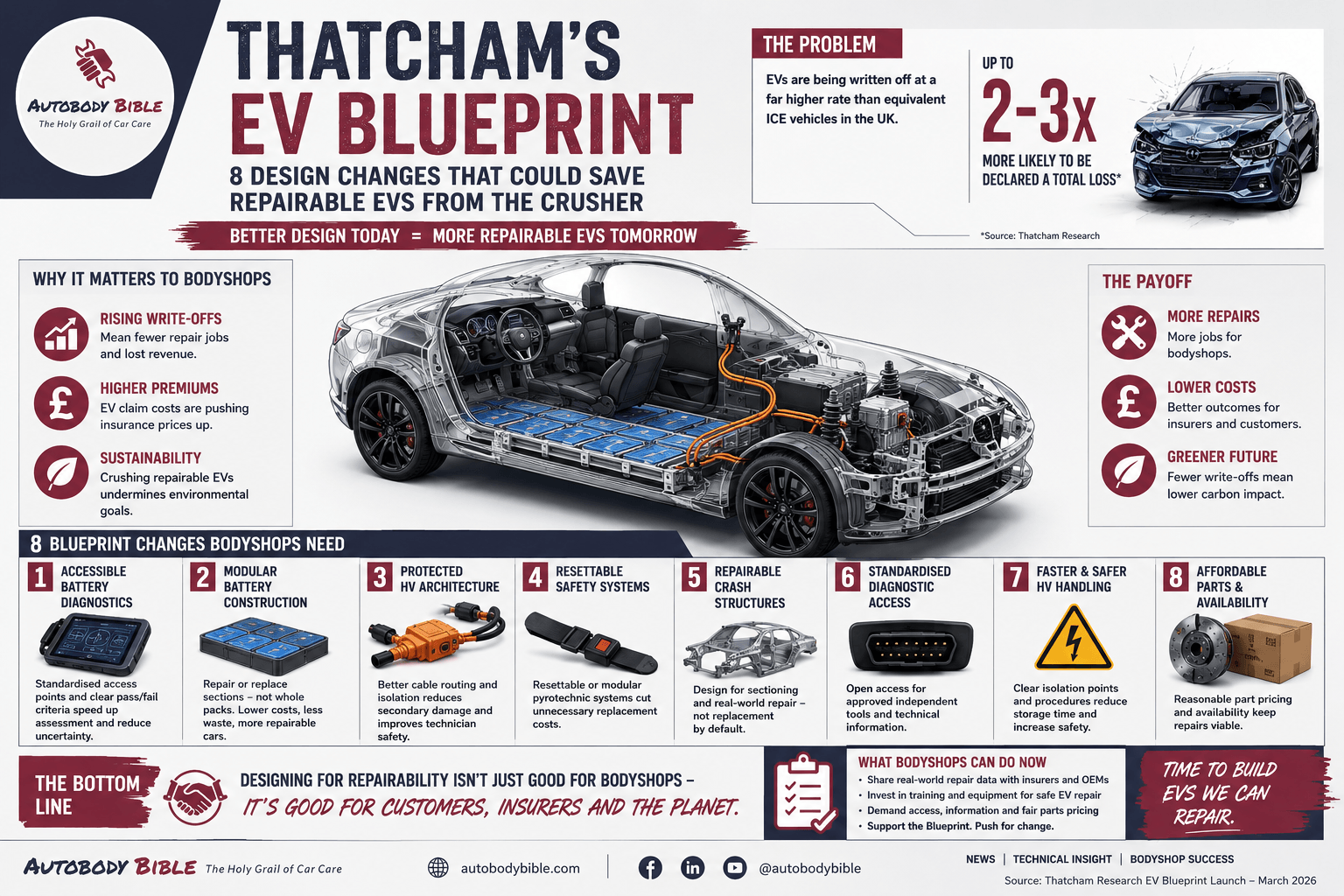
The headline concept behind the EV Blueprint is straightforward. Design EVs to survive repair, not merely survive crashes.
The proposals reportedly focus on eight broad engineering priorities.
Accessible battery diagnostics
This sits near the top of every repairer complaint list.
Today, many battery packs require extensive strip-down procedures or manufacturer-only tooling to determine internal condition after an impact. Even confirming the absence of damage can become commercially ruinous.
Bodyshops want:
- External diagnostic access points
- Standardised health reporting
- Clear pass/fail criteria
- Modular cell-level assessment
Without that, insurers default toward caution. Caution becomes write-off.
Modular battery construction
Replacing an entire battery pack because one isolated area suffered minor intrusion makes little economic sense. Most battery packs do have cell-level elements and until recently, these were often clustered into sub-modules, which dramatically change claim economics.
Tesla, Hyundai, BMW and others have moved in different directions here, but the market still lacks consistency. Some manufacturers permit partial interventions. Others effectively prohibit them outside factory-level environments.
That inconsistency destroys repair planning.
Protected HV architecture
High-voltage harness routing between the charger, batter, power control module, AC compressor and powertrain remains another problem.
Poorly protected HV systems can transform moderate collision damage into extensive replacement work. Better routing and isolation design would reduce secondary damage and speed up safe vehicle handling.
For workshops, that means shorter cycle times and reduced technician exposure.
The greenwashing problem
The automotive industry has spent years marketing EVs as environmentally responsible while ignoring what happens after first impact.
Crushing repairable vehicles carries a massive embedded carbon penalty.
Battery production alone represents a substantial environmental cost. Sending structurally salvageable EVs into recycling streams after moderate damage undermines much of the claimed sustainability benefit – and still the most valuable ‘black mass’ presents significant economic challenges to extract valuable materials such as lithium.
This is the contradiction sitting underneath the entire Blueprint debate.
Manufacturers optimise for:
- Euro NCAP performance (voluntary)
- Production efficiency
- Assembly simplification
- Manufacturing margin
- Weight reduction
Repairers optimise for:
- Repairability
- Parts access
- Labour viability
- Safe diagnostics
- Insurer economics
Those goals increasingly collide.
What bodyshops are seeing right now
Talk to UK repairers handling EV volume and the same themes appear repeatedly.
One large-network repair manager recently described a premium EV that sat in storage for nearly three weeks awaiting battery authorisation despite no confirmed pack damage. Another independent specialist reported insurers refusing repair approval because replacement cast sections were unavailable inside commercially viable timescales.
Then there is the tooling issue.
EV capability now demands:
- HV technician certification
- Insulated tooling
- Thermal event management
- Dedicated quarantine space
- Battery lifting systems
- OEM-approved calibration procedures
That investment only works if repair volume exists.
High write-off rates threaten the business case for independent EV capability itself.
Insurers are watching closely
The insurance sector has become increasingly nervous about EV claims inflation.
Repair severity continues rising. Courtesy car duration rises with it. Salvage unpredictability complicates underwriting.
Premiums follow.
This is why Thatcham’s involvement matters. It gives insurers a structured technical framework to pressure manufacturers with something stronger than anecdotal complaints.
The next stage will be interesting.
There is an often mis-understood dynamic. OEMs are not likely to re-engineer major assemblies because of a protocol issued by a third party – even Euro NCAP – unless there is some advantage. Most OEMs know about the issues, and are working towards solutions, but from 2026 that looks like fresh product somewhere after 2028. It is vital the conversation form the following continues:
- Insurers
- Fleet operators
- Leasing companies
- Large repair networks
- Consumer groups
Residual value risk alone may force change.
The independent bodyshop risk
Independent repairers face the biggest danger if repairability deteriorates further.
Large manufacturer-approved groups may survive inside tightly controlled OEM ecosystems. Smaller businesses could find themselves excluded entirely from profitable EV repair activity.
That would reshape the collision sector over the next decade.
The irony is obvious. The aftermarket kept older vehicle fleets economically viable for generations. Now parts of the EV market are drifting toward sealed-device economics more familiar to consumer electronics than automotive engineering – especially the more recent brand arrivals.
Replace. Don’t repair.
That approach will not survive sustained insurer pressure.
What happens next
The success of the EV Blueprint depends on one thing. OEM cooperation.
Some manufacturers genuinely understand the problem already. Others still appear fixated on production efficiency over downstream repair economics.
Bodyshops should watch closely for movement in five areas:
- Published battery assessment procedures
- Sectional repair guidance for cast structures
- Independent diagnostic access
- Parts pricing strategies
- Resettable safety system adoption
Those decisions will shape EV profitability inside the repair sector far more than another round of government EV adoption targets.
Because the real question facing the industry is no longer whether EVs are the future.
It is whether the future is repairable.