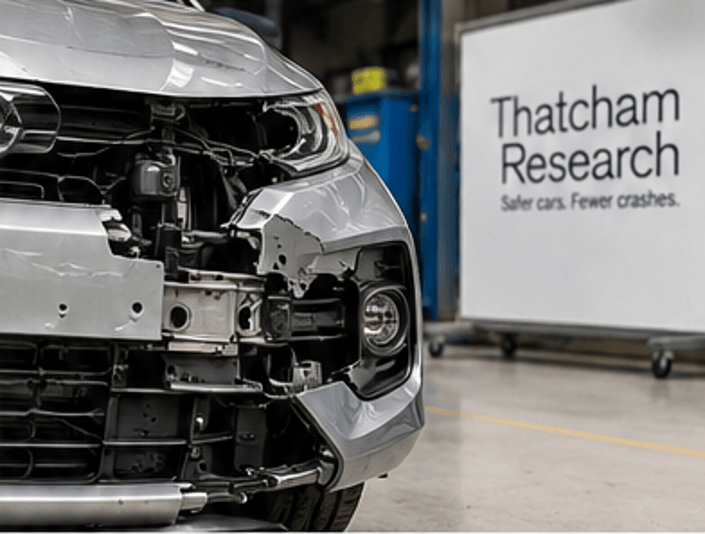
Thatcham Research and the international Research Council for Automobile Repairs (RCAR) are pushing manufacturers to make vehicle repairability a design priority. With comparable low-speed collisions producing vastly different repair costs, the consequences extend far beyond the insurance industry.
A vehicle requiring seven hours of repair work after a standardised low-speed impact is one thing. Another vehicle requiring 47 hours following the same test is something else entirely.
The difference is not necessarily the severity of the collision. It is how the vehicle was designed, where its components sit, how impact energy travels through the structure and how much must be dismantled or replaced to restore it.
Figures highlighted by Thatcham Research illustrate the problem. One family SUV required 59 replacement parts following an RCAR impact test. A comparable vehicle needed just 13.
For bodyshops, those numbers represent labour capacity, parts expenditure, repair planning and the difference between an economically viable repair and a total loss.
If manufacturers can engineer vehicles to protect occupants during serious collisions, why are apparently minor impacts still producing such expensive repair bills?
Repairability must begin at the design stage, way ahead of production
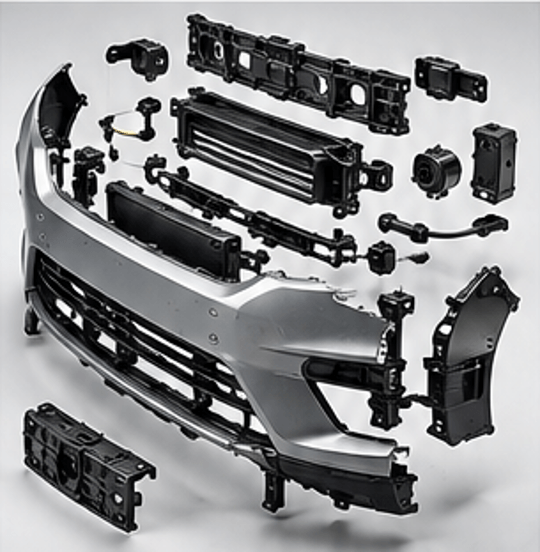
Exploded bumper assembly illustration. Component arrangements vary by vehicle. AI-generated image.
Vehicle manufacturers invest heavily in crashworthiness, occupant protection, pedestrian safety and increasingly complex advanced driver assistance systems (ADAS). Repairability has not always received the same attention as NGO lobbying and law combined with reduced revenue make every moment a fight for survival.
The front bumper skin has become a wrapper for all sorts of technology, which for the public means a slight knock or scratch appears to require a straightforward repair. Yet, an impact at parking speed can damage several of these components without producing dramatic external deformation.
The repairer then faces a growing list of operations. Remove the bumper assembly. Inspect the underlying structures. Check sensor brackets and mounting tolerances. Replace damaged components. Reassemble. Carry out the manufacturer-required diagnostic operations and calibrations.
RCAR low-speed crash testing exposes differences in vehicle damageability and repair costs. A vehicle can achieve excellent occupant safety results yet perform poorly in low-speed damageability testing. The two assessments measure different things.
Seven hours versus 47 hours
7 hours | 47 hours • 13 parts | 59 parts
Reported Thatcham comparisons, vehicle identities and test details require confirmation before publication.
The comparison demonstrates the commercial influence of design decisions. The second vehicle requires approximately 6.7 times as many labour hours. At a hypothetical £60 hourly rate, the difference is £2,400 before parts, paint materials, calibration or additional charges.
A vehicle occupying workshop space for additional days restricts throughput. Delayed parts increase work in progress. Insurers face higher repair expenditure and mobility costs. Customers wait longer. A larger estimate does not automatically benefit the bodyshop, particularly when specialist operations interrupt production.
| Vehicle A: 7 repair hours | Vehicle B: 47 repair hours |
Parking AEB: preventing the collision altogether
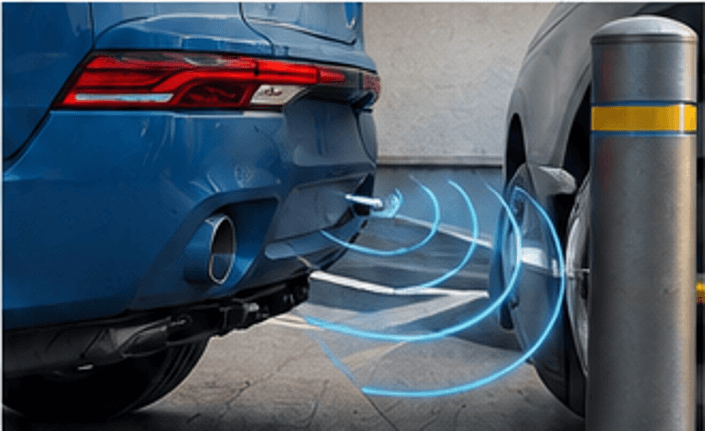
Parking AEB detects obstacles during low-speed manoeuvres. AI-generated illustration.
The RCAR campaign also highlights wider adoption of parking autonomous emergency braking (AEB). This technology detects obstacles during low-speed manoeuvres and applies the brakes when a collision is imminent.
The reported RCAR estimate suggests wider adoption could reduce claims frequency by up to 15% globally. This is a projection, not a measured UK-wide reduction. Performance depends on operating conditions, obstacle detection, sensor coverage and manufacturer control strategy.
Fewer minor collisions would mean fewer bodyshop jobs, a desirable safety outcome. Yet additional sensors bring repair considerations: mounting position, alignment and manufacturer-specified checks must be addressed.
ADAS positioning is becoming a repair cost issue
One manufacturer may place a radar module where minor bumper deformation damages its mounting bracket. Another may protect the module and make its mounting independently serviceable. Similar external damage can then produce very different invoices.
Can the bracket be replaced separately? Does the manufacturer permit adjustment? What inspection criteria apply? Is calibration required after removal and refitting? Which tools and software access are necessary? Answers must come from current, vehicle-specific repair information. There is no universal calibration rule for every bumper removal.
Repair before replace: an uncomfortable discussion
Repairing rather than replacing components makes commercial and environmental sense when technically authorised. A bumper cover may be repairable, a fractured radar mount may not be, and a structural section may require a prescribed replacement procedure.
There are performance limits about how a bumper skin can be repaired in front of or around things like RADAR modules, which include zero metal and strict paint thickness specifications. Some manufacturers state any bumper skin damaged anywhere should be replaced, while others – more often than not – show the zones where normal repair techniques should not be used.
It’s important to use the manufacturer’s documentation when deciding how to repair a large, and sometimes expensive, bumper skin.
The cost of getting vehicle design wrong
The Association of British Insurers reported £2.9 billion in motor claims payments in the first quarter of 2026. Vehicle repairs accounted for £1.9 billion, and the average accidental damage claim reached £3,699, an 8% quarterly increase. In the second quarter, total motor claims payments reached £3.2 billion and the average claim payout was £4,900, a different measure from the accidental damage figure.
Expensive headlamps, radar modules and structural assemblies influence economic repair decisions. On an older vehicle, repair costs can approach the insurer’s total-loss threshold. Electric vehicles add battery enclosures, underbody protection, high-voltage cabling and manufacturer inspection requirements. Better protection and authorised localised repair procedures could preserve repairable vehicles.
Are manufacturers starting to listen?
Vehicle manufacturers have seen profits eroded by significant system additions and increased engineering costs in response to NGO lobbying as well as changes in type approval law. The gap between the best and worst repair processes remains substantial. Most of the manufacturers now see repair with increased importance, because of the potential profit.
Physical damageability is only part of the equation. The cost and time to obtain new components, the associated calibration requirements and access to repair information determine how readily a vehicle can return to the road.
What should bodyshops do now?
Bodyshops can improve damage assessment by including hidden structures, sensor mounts and manufacturer inspection requirements. Vehicle damage estimators should identify all operations before committing to costs and completion dates.
Repairers could record cases where design creates disproportionate costs: inaccessible fixings, sensor bracket failures, complete assembly replacement and unavailable individual parts. Real repair evidence can help vehicle manufacturers design better cars in the future.
The bodyshop needs a seat at the design table
The September RCAR conference brought together 19 research institutes from 15 countries. Its priorities included repairability during development, wider parking AEB adoption and repair over replacement where authorised.
Manufacturers that design vehicles requiring fewer parts, fewer hours and fewer specialist operations after low-speed impacts create a measurable advantage. Insurers can reflect that advantage in risk assessment; repairers can demonstrate it through completed repairs.
The seven-hour versus 47-hour comparison should concern every manufacturer. The next step is to identify the models behind these differences, publish comparable repair performance data and make repairability a competitive consideration for vehicle buyers.
Sources and further reading
- Thatcham Research, RCAR repairability announcement, 29 September 2026
- Thatcham Research, Insurability by Design
- Association of British Insurers, Q1 2026 motor insurance claims
- Association of British Insurers, Q2 2026 motor claims figures
Editorial note: Vehicle identities behind the reported 7 versus 47-hour and 59 versus 13-part comparisons require verification against original test data. The £60 hourly rate is illustrative.