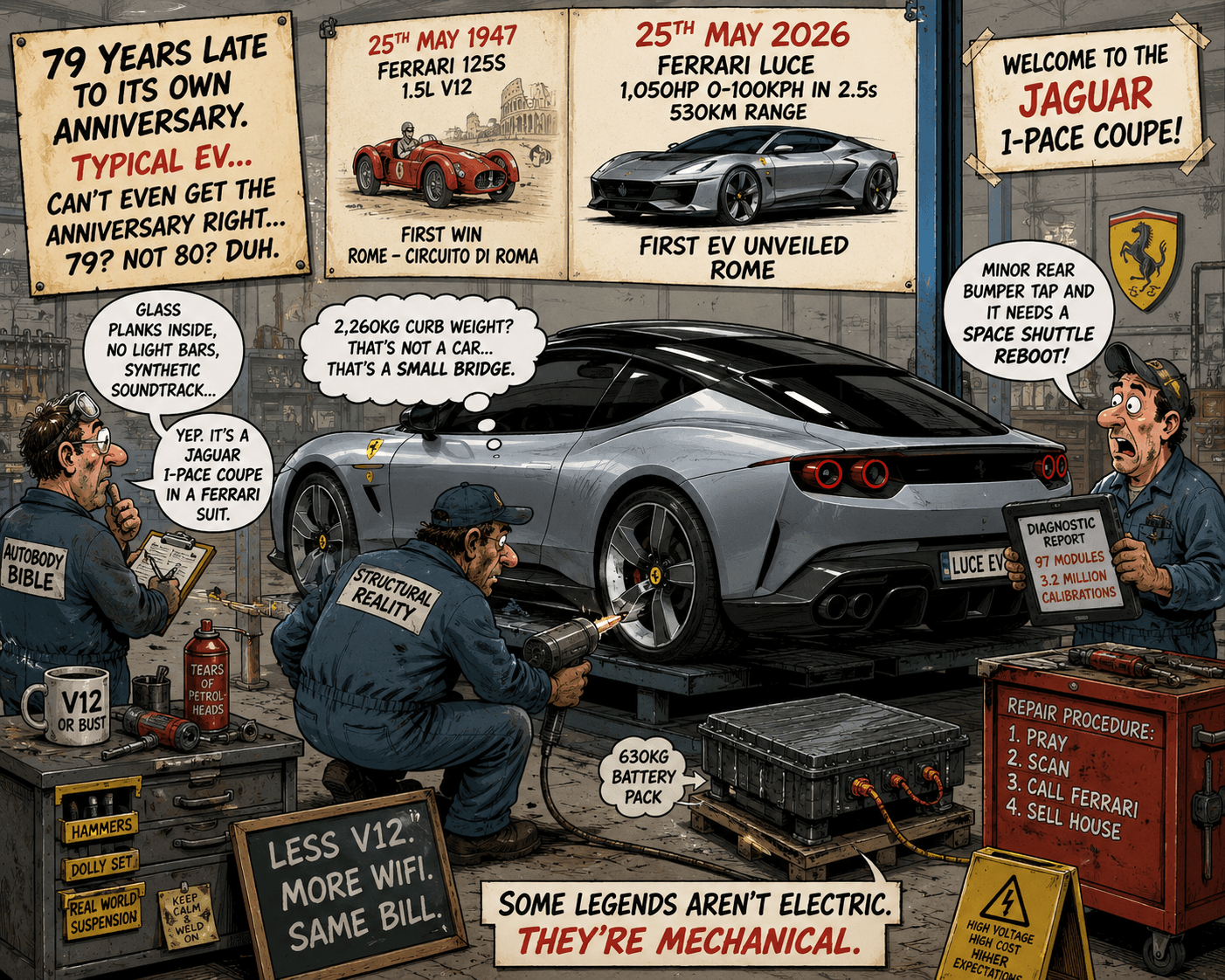
On 25th May 1947, a tiny red barchetta with a 1.5-litre V12 howled around the streets near the Baths of Caracalla in Rome and handed Ferrari its first competitive victory. The car was the 125 S. The engine displaced just 1497cc. Twelve cylinders. Colombo-designed. Mechanical insanity in miniature form.
On 25th May 2026, Ferrari returned to Rome to unveil its first fully electric production car, the Luce. A five-seat, 2,260kg, four-door fastback with synthesised drivetrain audio, hidden OLED rear lamps and enough battery mass to qualify as regional infrastructure.
One small problem.
1947 to 2026 is 79 years.
Apparently nobody in Maranello checked the maths before building the entire launch campaign around the anniversary.
That sums the car up perfectly.
Meet the Jaguar I-Pace Coupe
Ferrari insists the Luce is a radical new interpretation of Ferrari DNA. The company calls it a deliberate leap into the future. Reuters called it a “bold leap into an uncertain electric era.”
From some angles it looks less like a Ferrari and more like someone enlarged a Jaguar I-Pace, flattened it slightly and handed the surfacing over to an Apple design team running entirely on oat milk and industrial architecture magazines.
Which is not far from the truth.
The Luce was styled by Jony Ive’s LoveFrom collective, alongside Marc Newson. Ferrari gave them unusual freedom. The result is a car that abandons nearly every established Ferrari proportion and visual cue.
No side strakes. No theatrical intake sculpture. No aggressive surfacing. No visual engine story because, obviously, there is no engine.
Instead you get a monolithic dark glass canopy stretching almost nose-to-tail, floating aerodynamic elements and hidden rear lighting that only appears when the car wakes up.
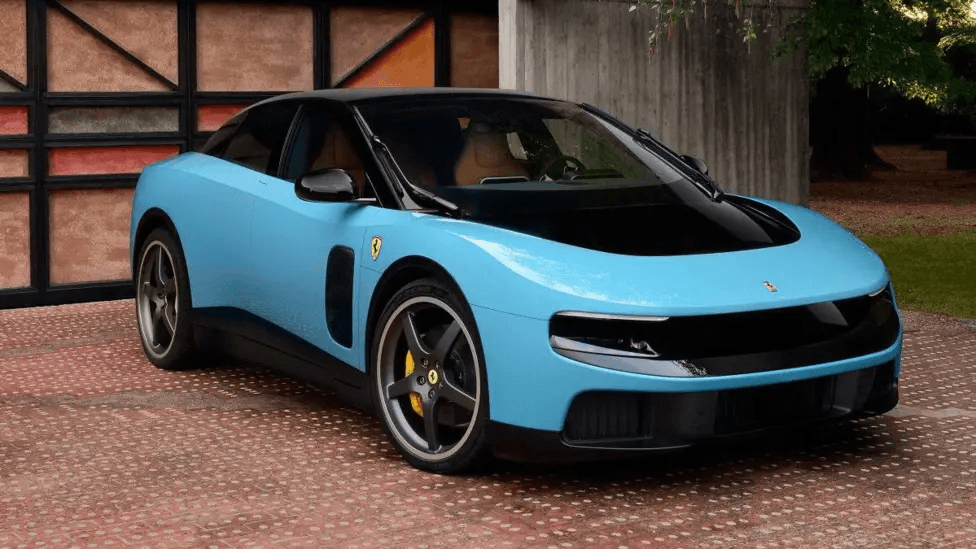
No light bars though. Credit where it’s due. Someone in Italy still has standards.
Inside, Ferrari has gone fully minimalist tech-luxury. Glass planks. Floating forms. Sparse controls. The sort of cabin that makes traditional Ferrari switchgear look like it came from a Panavia Tornado.
You can almost hear the design briefing.
“Make it tactile.”
“Make it singular.”
“Make it feel curated.”
Meanwhile the engineer in the corner is staring at a 630kg battery pack and wondering how physics became optional.
1,050hp and a soundtrack generated by algorithms
Ferrari knew the sound problem would define public reaction long before launch day.
A Ferrari without noise is like Monza without tifosi. Technically functional, emotionally dead.
So the company avoided fake V12 sound synthesis and instead amplified the natural frequencies generated by the four electric motors and drivetrain components. Accelerometers mounted in the rear axle feed signals into a filtering and equalisation system that broadcasts the processed audio both inside and outside the vehicle.
Ferrari describes the result as rooted in “the physics of rotating machinery.”
That sentence deserves framing.
The Luce effectively turns bearing noise and electromagnetic harmonics into brand identity.
Performance mode gives occupants the full synthetic-electric symphony. Range mode cuts the drama back substantially, reduces power to 429hp, disconnects the front motors and limits speed to 280kph to preserve battery range.
Somewhere an F40 is leaking fluids in protest.
Still, Ferrari deserves some credit here. At least it resisted the temptation to bolt a speaker-based fake V12 soundtrack underneath the rear bumper like Dodge did with the Charger Daytona.
The company understands that pretending an EV is an ICE car rarely works. Hyundai’s Ioniq 5 N succeeds because it treats the entire exercise with a slight wink. Ferrari cannot afford irony. Ferrari customers expect mythology.
That is much harder.
The engineering is serious, even if the concept remains questionable
Strip away the launch theatre and the Luce is technically fascinating.
Four independent motors. Torque vectoring at each wheel. Fully active chassis systems. Rear-hinged doors. An 800-volt architecture. 350kW charging. 0-100kph in 2.5 seconds. 310kph flat out.
Ferrari says each corner operates independently for steering, damping and power delivery. That matters because EV mass remains the central unsolved problem in high-performance electric cars. You can disguise weight dynamically. You cannot eliminate it.
The Luce weighs nearly 2.3 tonnes.
That is around 700kg heavier than a Ferrari 296 GTB.
For bodyshops, the technical implications are enormous.
This is another ultra-low-volume, ultra-high-complexity aluminium-intensive EV entering the collision ecosystem. Multi-material construction. Structural battery protection zones. Active aero. Hidden OLED lighting systems. Four-motor calibration procedures. Independent chassis control systems.
A minor rear quarter impact on this thing could trigger diagnostic procedures that look more like aerospace commissioning than traditional accident repair.
And that is before insurers start asking difficult questions about residual values and battery inspection protocols.
Ferrari customers may absorb the bills. Insurers will not enjoy writing them.
Ferrari knows this is a statement car
Reuters reported Ferrari has already delayed plans for a second EV because demand remains uncertain. Lamborghini has backed away from a pure EV launch altogether and pivoted back toward hybridisation.
That matters.
Behind the headlines, most premium performance manufacturers are discovering the same uncomfortable truth. Wealthy buyers say they support electrification right up until someone removes the naturally aspirated V12 from the garage.
Ferrari understands this better than anyone.
The Luce is not designed to replace the company’s combustion halo cars. It exists because Ferrari cannot allow Porsche, BYD or Rimac to define what ultra-luxury electrification becomes.
So Maranello built a technological manifesto.
An electric Ferrari with hidden tail lamps, glass architecture, Apple-industrial design language and synthesised drivetrain acoustics, launched exactly 79 years after Ferrari’s first victory.
Close enough, apparently.