Europe’s car market has started to fracture.
Not collapse. Not contract. Fracture.
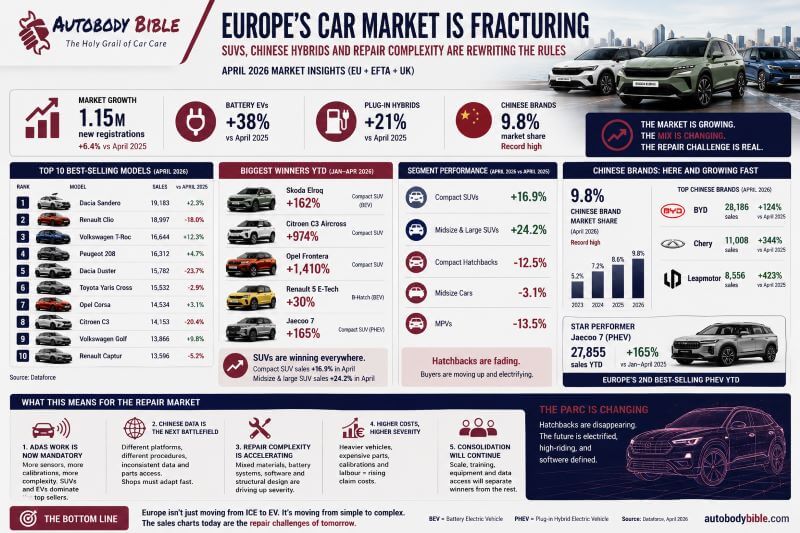
The April 2026 European sales figures show a market still growing on paper, registrations rose 6.4% across the EU, EFTA and UK. But underneath the headline numbers sits something far more interesting, and far more dangerous for Europe’s established manufacturers.
The old centre ground is disappearing.
Hatchbacks that once defined Europe are fading. Traditional family saloons are being shoved aside. Buyers are piling into electrified SUVs, cheap Chinese plug-in hybrids, compact crossovers and aggressively priced EVs that many bodyshops still barely understand how to repair properly.
The market is changing shape faster than the infrastructure around it.
That should worry insurers, OEMs and repairers equally.
Take the Dacia Sandero. Europe’s favourite budget car clawed its way back to the top of the monthly sales charts in April with just over 19,000 registrations. On the surface it looks like business as usual. Cheap transport still wins in uncertain economic conditions.
Except it isn’t business as usual at all.
The Sandero remains down more than 22% year-to-date. The Duster has collapsed by more than a quarter. Citroen C3 sales are falling heavily. Peugeot 208 volume is sliding. Ford has effectively abandoned the traditional European car market entirely.
Meanwhile the fastest-growing products are the Skoda Elroq, Renault 5 E-Tech, BYD Seal U, Jaecoo 7, Citroen C3 Aircross, Opel Frontera and VW Tayron.
Almost all of them electrified. Almost all of them SUVs or crossovers. Almost all of them packed with increasingly expensive technology.
That is the real story buried in these numbers.
Europe is no longer transitioning from combustion to electric. It is transitioning from simplicity to complexity.
The Skoda Elroq may end up becoming the defining vehicle of this era. Sales surged more than 160% year-to-date. It sits right in the sweet spot modern buyers want, elevated driving position, mid-size footprint, family practicality, EV running costs, conventional styling, familiar Volkswagen Group switchgear and heavy ADAS integration.
It is the anti-Tesla.
That matters because Tesla suddenly looks vulnerable in Europe despite impressive headline growth. The Model Y remains Europe’s best-selling EV across the first four months of the year. Yet after topping the market in March, it crashed down to 39th place in April.
Tesla still behaves like a tech company pretending to be a car manufacturer. Deliveries arrive in violent waves. Pricing changes constantly. Insurance costs remain ugly. Repair times remain controversial. Parts availability still fluctuates.
European buyers increasingly appear to want something less theatrical.
Something normal.
That is why Skoda is quietly becoming one of the smartest operators in Europe. While Volkswagen itself struggles with identity problems across its EV range, Skoda keeps delivering sensible, well-priced electrified SUVs that look like actual cars rather than consumer electronics.
And while Europe argues with itself about tariffs and industrial policy, the Chinese manufacturers have simply arrived and started taking market share.
Not tiny amounts either.
Chinese brands reached a record 9.8% share of the European market in April. BYD alone sold more than 28,000 vehicles in the month. Chery – consisting of the brands Jaecoo, Omoda, JeTour and Chery – exploded by 344% (April 2025: 5778, April 2026: 25606). Leapmotor jumped more than fourfold (April 2025: 1678, April 2026: 8782).
This is no longer about bargain-bin EVs.
The genuinely disruptive products are plug-in hybrid SUVs.
That should set alarm bells ringing in every European boardroom because Chinese brands have identified exactly where Europe remains weak. Buyers still worry about charging infrastructure, residual values and battery longevity, so Chinese manufacturers are flooding the market with heavily equipped PHEV crossovers that offer electric commuting without full EV commitment.
The BYD Seal U now dominates Europe’s plug-in hybrid rankings. The Jaecoo 7 has become one of the fastest-growing vehicles in the entire market.
These are not niche curiosities anymore. They are volume fleet and retail products entering insurer repair networks right now.
Most bodyshops are nowhere near ready.
That is the uncomfortable truth running through all of this data.
The modern European repair environment is becoming brutally complicated.
Ten years ago an independent repairer mainly dealt with Ford, Vauxhall, Volkswagen, Peugeot, Renault, BMW and Mercedes.
Today they face BYD, Jaecoo, Omoda, Leapmotor, Xpeng, Zeekr, Dongfeng, Voyah, Geely and Chery.
All arriving with different battery systems, different calibration procedures, different parts supply chains and different repair documentation standards.
The industry still talks about EV adoption as though the major challenge is high-voltage safety training.
That phase has already passed.
The next problem is operational fragmentation.
How does a medium-sized independent bodyshop source structural repair data for a Jaecoo 7? How quickly can they get radar brackets for a BYD Sealion 7? Which calibration targets are approved? What happens when a damaged Chinese-market module requires coding access through a restricted OEM gateway?
Those questions are arriving faster than the answers.
And the vehicles themselves are becoming heavier, taller and structurally more complicated at the exact moment insurers are trying to control claim severity.
That contradiction sits at the heart of the modern repair crisis.
SUV dominance continues to intensify. Compact SUVs rose nearly 17% in April. Midsize and large SUVs climbed more than 24%.
Every one of those vehicles brings more sensors, more expensive lighting systems, more structural aluminium, more mixed materials, larger wheel assemblies, more calibration requirements, higher battery integration.
Repair costs rise almost automatically.
Then there’s Stellantis, which increasingly resembles a giant industrial chemistry experiment. Some products are exploding in popularity, the Citroen C3 Aircross rose nearly tenfold year-to-date. The Opel Frontera surged more than fourteenfold.
At the same time core models like the Peugeot 308 and Opel Astra continue to weaken badly.
Stellantis appears to be chasing every market segment simultaneously with overlapping brands, overlapping platforms and overlapping identities.
That might work financially.
For repairers it creates another layer of complexity. Shared vehicle architectures no longer guarantee shared repair strategies. Two Stellantis products built on effectively identical underpinnings can still require completely different calibration routines, parts sourcing pathways and repair methods.
Europe’s car market has entered a strange new phase where the product itself matters less than the software, battery layout and sensor architecture hidden underneath it.
The April sales figures don’t just show what Europeans are buying.
They show what the European repair market is going to see much more frequently over the next few years.