Chery recalls covering 23,667 vehicles in South Africa should make collision repairers pause before writing the estimate. The defects concern rear-axle welds and brake pipes. A broken component arriving at your bodyshop could be evidence of what caused the crash. [1]
That changes the job. Strip it, replace it and discard it too quickly, and you could lose the evidence needed to separate manufacturing failure from collision damage. The repair plan starts with an investigation.
South Africa’s National Consumer Commission announced the action on 10 November. It covers 17,508 Tiggo 4s and 2,685 Omoda C5s with rear-axle weld concerns, plus 3,474 Tiggo 8 Pro Max 2.0s with a front brake-pipe defect. [1] Shortly after authorities in Malaysia and China initiated actions as well, working with the parent vehicle manufacturer, Chery.
Three model groups. Two faults. Plenty for an estimator to establish before ordering parts.
The Tiggo 8 problem concerns a brake pipe contacting the turbocharger assembly, with wear leading to fluid leakage and reduced braking performance. “Egg fried brakes” makes a memorable headline, but the published failure mechanism is contact and wear. It does not establish that the turbocharger cooks the pipe. [1]
That matters in the workshop. Heat damage, abrasion and impact damage require different diagnoses. Adding shielding does not repair a worn pipe. Moving it away from the turbocharger does not establish that it remains fit for service. The applicable manufacturer instructions must determine the repair.
Australia has already published a separate brake-pipe recall for 5,556 Tiggo 8 Pro 2.0 vehicles across the 2023 to 2026 model range. Campaign RCB-2602, issued in June, identifies chafing against the engine. Similar wording warrants attention, but it does not make the Australian and South African vehicle populations interchangeable. [2]
For bodyshops, the wider implication concerns reassembly. Pipe routing, clips and brackets belong in the repair method whenever collision work disturbs them. A component can look tidy, pass a stationary visual check and still need further assessment against the manufacturer’s specified installation.
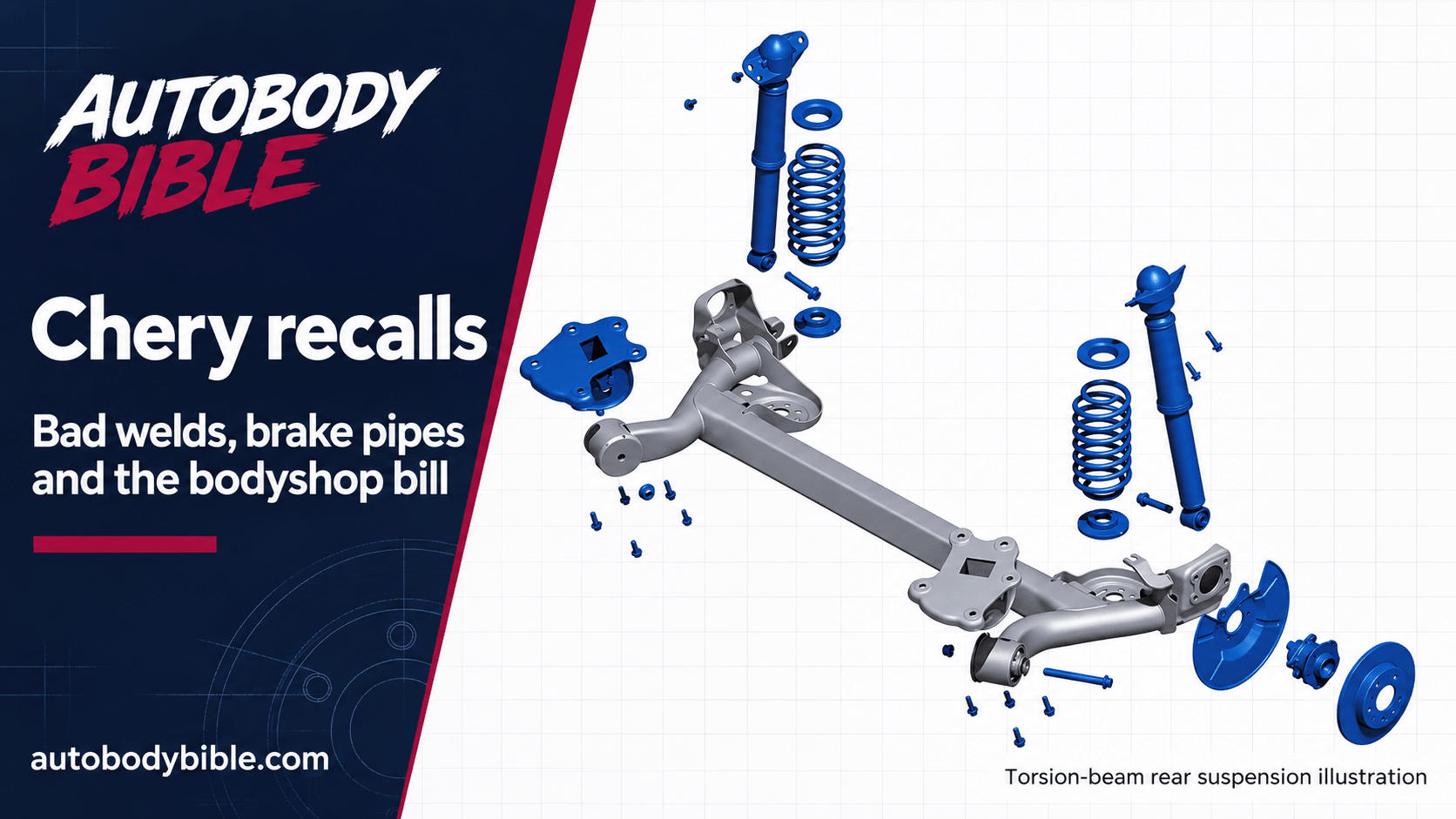
The suspension issue demands equal care. Chery identifies the suspect joint as the weld between the rear suspension torsion beam isolator bush bousing and the trailing arm element of the assembly. There are only two connections to the body taking all the fore / aft / lateral loading, while the dampers provide two further connection points. If any of these joints fail it will affect vehicle control. The manufacturer says affected vehicles will be inspected, with complete rear suspension torsion beam replaced where required. [3]
The announced remedy is not an invitation to repair the joint with a welding torch. A bodyshop needs an approved method before undertaking any structural repair to a suspension assembly – and no such process or approval exists. The ability to produce a weld does not establish the suitability of the proposed repair.
There is also a claims-assessment problem. A displaced rear wheel and damaged quarter panel do not, by themselves, establish the order of events. Did an impact damage the suspension, or did a suspension failure precede the impact? That requires evidence. A recall notice alone cannot answer it.
Photographs taken before dismantling, component markings, fracture surfaces and surrounding damage can support that assessment. Preserve suspect parts and raise the concern with the insurer and manufacturer before disposal. Those decisions deserve a place on the job record, with the time required included in repair planning.
UK readers need a further distinction. Omoda’s current UK specification lists independent rear suspension for the Omoda 5 petrol. The torsion-beam version involved in the overseas discussion cannot simply be treated as the same car underneath. [4]
However, blanket reassurance would also be wrong. Chery’s UK approved-used specifications list a torsion-beam axle on the 2026 Tiggo 4 Summit Super Hybrid. Suspension layout alone proves neither inclusion nor exclusion from a particular recall – even though Tiggo 4 is part of a recall action in other countries. The affected production batch and VIN remain decisive. [5]
This is where market variations become a cost to the repair business. A familiar model name is insufficient for selecting an axle, locating mounting dimensions or choosing a repair method. Your technician needs information for the vehicle on the lift. A document for another market may describe different hardware.
The commercial questions follow immediately. If a collision repair must wait for a recall inspection, who authorises transport? Who agrees the additional storage? Can the mechanical and body repairs proceed together, or does one operation depend on the other?
These are questions to settle before committing to a completion date. “Free recall repair” does not describe every cost incurred by a bodyshop holding a customer’s vehicle.
Chery says replacement parts are available in South Africa and repairs will be prioritised. It also states that inclusion does not mean every vehicle has a defective axle. Those points deserve reporting alongside the fault. They do not establish UK parts availability or a delivery date for your individual job. [3]
Then comes the reporting issue.
The South Africa NCC says it opened an investigation in October 2026 into allegations that Chery recalled vehicles without notifying the commission. That investigation remains ongoing. It is an allegation about regulatory notification, not a finding that every owner was kept uninformed. [1]
For the repair industry, access to recall information has a direct operational value. An independent workshop needs to identify outstanding actions before it commits to parts, repair sequencing and handover. Manufacturers should make that information easy to obtain against a VIN, with a clear route for technical queries.
The alternative creates avoidable uncertainty. An estimator cannot price an undefined inspection. A workshop controller cannot promise a completion date without knowing which operations remain outstanding. A customer deserves an explanation that reaches beyond “we are waiting to hear”.
The same demand applies to repair data. Correct component identification, current procedures and recorded campaign completion should be accessible to the businesses repairing these vehicles. Every manufacturer asking insurers and bodyshops to support its products should expect scrutiny of that support.
Chery’s recalls concern manufacturing defects. The body repair industry’s interest is what happens when those vehicles arrive damaged, with an insurer awaiting an estimate and an owner awaiting answers.
Your workshop needs enough information to establish the damage, order the correct parts and defend the completed repair. Manufacturers must provide it. Insurers must recognise the work involved. The technician should not have to supply the missing information through guesswork.
Sources
1. South Africa National Consumer Commission, 10 November 2026
2. Australian government recall REC-006636
3. Chery Group South Africa statement, 10 November 2026
4. Omoda UK, Omoda 5 petrol specifications
5. Chery UK approved-used specifications, 2026 Tiggo 4 Summit Super Hybrid