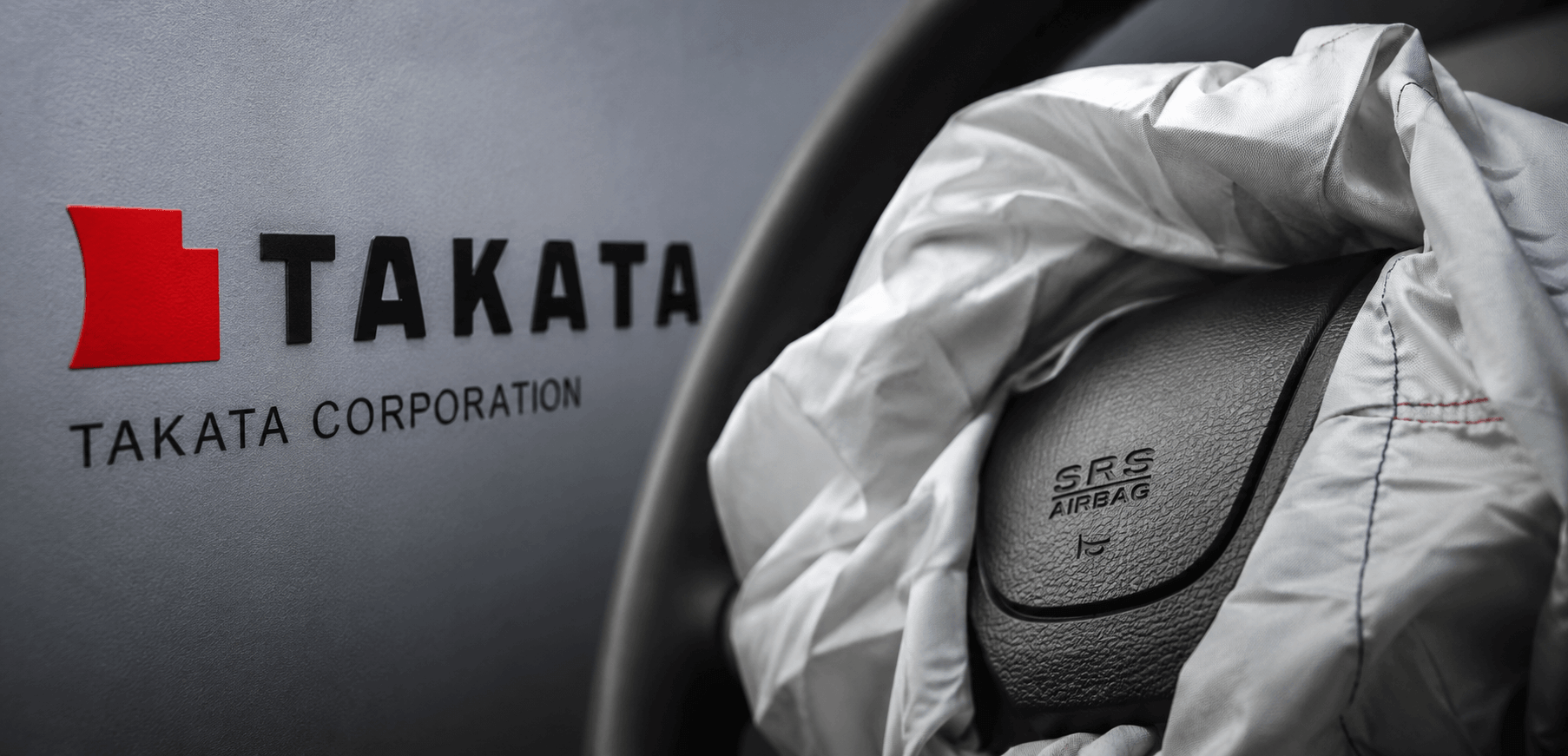
Takata Corp originally made textiles, but decided on the back of huge external pressure to produce whole SRS airbags from 1985 onwards. An early investor in Takata was Honda, eventually owning half the company.
They remained a B2B supplier, out of the limelight until a major global investigation into price fixing came to a head in Europe, Japan and the USA during 2013. For the first time agencies from all three countries simultaneously investigated allegations of price fixing, including seat belts as well as airbags. Many companies were fined and executives jailed across the three prosecuting regions, including the major SRS suppliers – AutoLiv, Takata, TRW, Tokai Rika Co. The result for Takata was a fine of $71.3 million and three executives were jailed in the USA.
However bigger trouble was brewing for Takata.
Airbags and what they do
The objective of an airbag is to be deployed rapidly, and then control deflation to decelerate the occupant which prevents hitting hard objects like the steering wheel or parts of the dash panel. Each SRS component is calibrated specifically for the vehicle application. From the start of the impact to airbag deployment typically takes 0.2 seconds.
The airbag is either inflated by generating gas either by inducing a chemical reaction at a controlled rate (typically used for driver airbags) or by controlled release from a pre-charged container (typically used for larger applications such as larger curtain airbags).
For solid gas generators, inflator powder (a mix of sodium azide and oxidising agent) is pressed into either pellets or wafers, and then built into the inflator cassette. The advantage of this first generation ‘standard’ SRS inflator was the production process was adapted from a long established and mostly safe system (munitions), the chemicals were relatively stable and the end user benefits far outweighed the risks. The SRS suppliers were under pressure to eliminate sodium azide from airbags because the un-deployed material is very, very toxic to humans.
Enter Takata
Takata blew the opposition away by announcing in 1999 that they had a sodium azide free solid propellant inflator – tetrazole. The automotive world swamped Takata with orders, and the company underwent rapid expansion whilst building new production plants in Mexico as well as the USA. Concerns soon surfaced as the supply of tetrazole was uncertain, and could not keep up with demand…. so by 2001 the company switched to ammonium nitrate instead. Commonly used in industrial explosives, this material was extremely sensitive to moisture content and prone to aging too. Crucially all the other SRS suppliers had experimented with this and rejected it due to instability, but Takata claimed they has a process that could stabilise the material.
What went wrong?
The first case of identifiable airbag failure occurred in 2009 when a 7 year old Honda had a low speed car park nudge which deployed the airbag. The driver’s jugular vein was severed – the accident investigation began. Three months later, the same thing happened, also on an older Honda. The investigation showed the debris which had caused the fatal injuries was parts of the driver’s airbag gas generator steel case – the gas generator had exploded, rather than generate gas as it was designed to do.
Takata said nothing.
The number of incidents began to rise, and the USA National Highway Traffic Safety Authority (NHTSA) started an investigation but closed it down by 2010 due to lack of evidence. The number of incidents continued to rise, and the vehicle manufactures panicked. There was no sensible support from Takata, there was no logical reason for these problems – and yet the problem was occurring with greater frequency. NHTSA re-engaged with the investigation, and the Senate demanded a hearing. Recalls were sporadic, dealing with only the driver’s side airbag and only for the hot / humid states of the USA – and still the problems surfaced right across the USA and beyond.
Takata said nothing.
The Senate hearing committee demanded a public hearing. Takata appeared, said there was no fault and refused to allow investigators access to internal documents. The Senate hearing committee were angered by the delaying tactics and demanded co-operation, fining Takata $14000 for each day they failed to give access. One former employee told the committee the issues that were found back in 2001, and how the company knew of the instability issues certainly before 2004 – the point where Honda were informed.
Safety at all of the Takata plants was paramount and there were no significant breaches of the comprehensive safety rules – but the production process was not perfect. Company inspectors found as early as 2002 that ammonium nitrate production was left open to the atmosphere during extended shut down periods (weekends, holidays) instead of being put into dry storage. There were concerns about the life span of the gas generator, and demand was so high some of the gas generator modules were built with too few pellets / wafers. Finally, the gas generator case design had some open issues too. All of these issues were flagged internally but not shared with all of Takata’s clients, or external agencies.
Takata admitted there was a problem for the first time on 19th May 2015.
What was the result?
Vehicle manufacturers made it very clear that Takata gave them no answers, but decided to replace the oldest modules with brand new ones. Takata finally admitted the issue could occur even in brand-new units coming off the assembly line. Only Takata had used ammonium nitrate – the other SRS suppliers eventually found alternatives to sodium azide and had none of the issues Takata faced.
In the USA alone the recall up to 2024 involved 67 million vehicles, killed 27 people and led to 400 recalls.
Why is this still a problem?
Takata ran into trouble in country after country, leaving vehicle manufacturers high and dry. The company faced bankruptcy, but were bought by Key Safety Systems in 2017 for $1.6 billion (KSS was bought by Ningbo Joyson Electronic Corporation – “Joyson Electronics” – in 2016). That process allowed Takata with all of the liabilities before 2017 to become ‘Old Co’, and allow the revised company to free from the major Takata issues.
Somehow Honda managed to take the share price hit, and survived even though the whole affair damaged them as a client as well as an investor.
Thanks to multi-government intervention, and the scale of the recalls, the remaining SRS airbag manufacturers were asked to produce replacement modules. The response was not what legislators wanted to hear:
- To solve the problem completely, re-designing a solid propellant airbag module would require new tests and possibly re-type approval. So, the decision was made not to re-design.
- That meant the replacement modules had to use the original Takata tooling, which meant using exactly the same solid gas generator technology with very similar risks.
- Long-term Takata SRS module exposure to high humidity combined with sustained high temperatures accelerated propellant instability. So, are certain climates where failure is more likely.
- In any event the SRS airbag manufacturers who were forced into supporting the Takata recall needed some sort of payment to help sort it out, while vehicle manufacturers took the whole financial hit of the recall.
That is why nearly a decade on from the Takata admission, the problem and recalls persist.