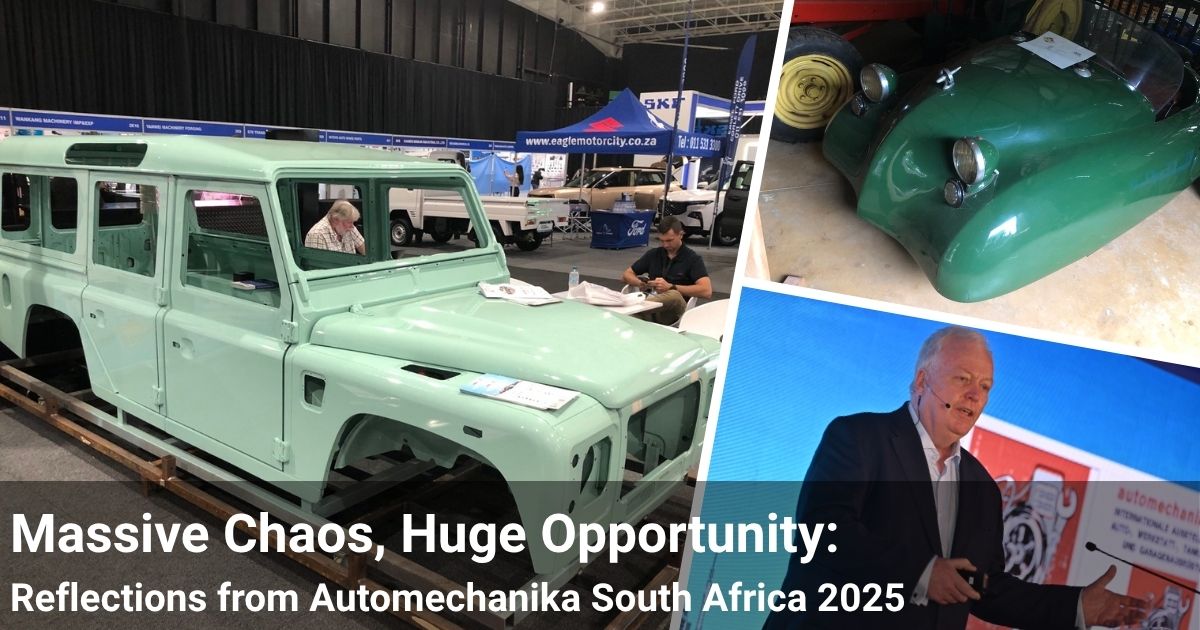
Standing before a packed audience in Johannesburg last week, I couldn’t help but think of 1971. That was the year the German car manufacturers’ association, the VDA, pulled out of the Frankfurt motor show, and the aftermarket was expected to follow suit quietly. Instead, the aftermarket said, Forgive me, “damn you!” and created Automechanika, the world’s first and only global aftermarket event.
More than 50 years later, the spirit of 1971 is alive and well in South Africa. The country’s automotive aftermarket is facing the same kind of disruption, tension, and opportunity that Europe confronted half a century ago, but on a global, electrified, and far more complex scale.
The Automotive Business: From Order to Chaos
If there’s a theme that ran through every one of my presentations this week, it’s that the global automotive industry has lost its rhythm.
Europe’s emission laws have become a bureaucratic maze: Euro V with two steps, Euro VI with five, and now a Euro VII so muddled that manufacturers themselves have rejected it. At the same time, Zero Emission Vehicle (ZEV) mandates in both the UK and EU are pushing brands to chase electrification targets without the charging infrastructure to support them.
Meanwhile, China, the “overnight success” that took forty years to build, has reached a point of industrial dominance unseen in history. The country now has the capacity to produce over 26 million cars annually, with factory space for more than double that. Massive domestic price wars have pushed Chinese manufacturers to flood export markets, using low-cost, high-content models to buy market share and secure vital foreign exchange.
The result? Massive chaos. But as I told audiences in Johannesburg and Cape Town, there’s also a huge opportunity.
The Single-Use Vehicle and the Vanishing Margin
The core of the challenge is what I call the “single-use vehicle.”
China’s rise has introduced a wave of inexpensive, highly featured vehicles that are brilliant to drive but almost impossible to repair profitably. A car selling for £8,000 or less cannot justify a £4,000 body repair, and when parts are scarce or unapproved, it often won’t even be attempted.
This creates a paradox for the aftermarket:
- More vehicles on the road
- More damage incidents
- But fewer repairable cars
The net result? Rising claim volumes, but shrinking repair margins. That’s not a South African problem, it’s a global one.
At the CRA (Collision Repair Association) conference, I joined insurers and repairers in exploring this very issue: how the balance of sustainability between repairer and insurer has broken down. Technology, ADAS calibration, and vehicle complexity have all accelerated costs faster than either side’s business model can adapt.
Both parties feel the squeeze:
- Repairers are caught between price control and process control.
- Insurers are caught between escalating claim costs and customer expectations.
The outcome, unless addressed collaboratively, is reduced repair capacity and increased total losses.
Europe’s Missteps, South Africa’s Moment
Europe has painted itself into a corner. Legislators are mandating electric vehicles while dismantling internal combustion without ensuring a practical transition path. Manufacturers are now juggling three parallel model programmes: petrol-hybrid, plug-in hybrid, and full electric, each requiring new supply chains, diagnostics, and safety procedures.
South Africa, by contrast, sits at a rare inflexion point.
While the domestic vehicle fleet is modernising, it remains technically diverse, a blend of ICE, hybrid, and imported BEV technologies. The aftermarket here can leapfrog many of the mistakes made elsewhere by building capability first, not just capacity.
That means:
- Embracing advanced diagnostics (particularly for ADAS and hybrid systems).
- Investing in technical training, not just equipment.
- And above all, reviving the spirit of independence that made the original Automechanika possible.
Diagnostics, Data and the Coming Complexity
One of the great frustrations in our industry is the uneven access to diagnostic data.
As I reminded attendees in Frankfurt earlier this year, fault codes (OBD II and beyond) follow four families: P for powertrain, B for body, C for chassis, and U for undefined. But when it comes to electric or hybrid systems, those tidy definitions collapse.
Each new model might scatter calibration data across multiple modules, each built by a different supplier. Unless that supplier has a proper aftermarket contract, even the best independent scan tools will lag behind OE systems by 6 to 9 months.
This is not theoretical; it’s happening now. For example:
- BMW’s Neue Klasse architecture removes 600 metres of wiring and centralises control into four processors: fewer parts, but more complexity.
- BYD and Geely platforms integrate power electronics, ADAS, and infotainment in proprietary formats.
- MG’s hybrid platforms, based on its Chinese parent, SAIC, mix Western body repair documentation with Eastern software logic; sometimes incomplete, sometimes brilliant.
South African repairers will increasingly face this blend of European frames, Chinese logic, and limited calibration support.
Insurers, Repairers and the New Compact
At the CRA insurer forum, we posed a provocative question: What’s the game changer for 2026?
The answer may not lie in technology but in collaboration.
The Consumer Protection Act (68 of 2008) guarantees the right to be “put back into the same position as before the incident.” But that can’t happen if repairers aren’t equipped to restore ADAS, or if insurers push for unrealistic repair costs on unrepairable vehicles.
The new compact must focus on:
- Transparent policy limits are communicated at the start of the claim.
- Recognition that ADAS and hybrid systems are safety equipment, not optional extras.
- Shared training initiatives between insurers, assessors, and repairers.
Only by restoring trust and knowledge-sharing can we navigate the new profitability equation.
The Spirit of 1971, Reimagined
If 1971 taught us anything, it’s that when the “big players” walk away, the aftermarket can build something better on its own terms.
The global shift of manufacturing power from West to East is not a death sentence for the repair industry; it’s a rallying cry.
South Africa’s repairers, insurers, and component suppliers are uniquely placed to redefine what sustainability means: not just in environmental terms, but in economic and technical resilience.
As I closed my final session at Automechanika South Africa, I reminded everyone:
“The solutions to the apparent disasters are in our own people.
Money, training, and data matter, but it’s the aftermarket’s collective ingenuity that will carry us forward.”
The chaos is absolute. The opportunity is greater still.