The European Commission facing dramatic implosion of vehicle manufacturing across the 27 member states. This was due to the stubbornly high cost of major assemblies required for electric powertrains for European manufacturers, the underlying profitability of internal combustion powered vehicles with auxiliary electric drive systems and inherently smaller batteries, and this;
- The EU27 have worked towards phasing out sales of new cars and LCVs with pure internal combustion engine (‘ICE’) powertrains from 2030.
- The EU27 planned to follow this with a complete ban on all internal ICE with auxiliary electric drive systems for new cars as well as LCVs from 2035.
- From 2019 most of the major parts and systems manufacturers in the EU27 either got out of the internal combustion engine component business or moved their operations, mainly towards China where a growing mixed BEV / ICE market still exists.
The shock finally reached the EU27 Commission during 2025, where Germany reported annual tooling investments made during the third quarter were down by more than 30 per cent, and an overall loss of a full 20 per cent of manufacturing activity by the end of the year. Several hundred thousand workers in the German automotive sector have lost their jobs since 2020, with the prospect of about the same losses again by 2029 – if nothing changes.
The announcement of the ICE death in 2025 was premature
China holds a lot of cards, and the European automotive sector with inherently higher overheads such as energy along with using materials as well as finished sub-assemblies made in China, are well and truly caught. Until the supply of processed rare earth metals and finished components for electrification arrive in quantity form other parts of the world, line stoppages, plant closures and loss of manufacturing will continue.
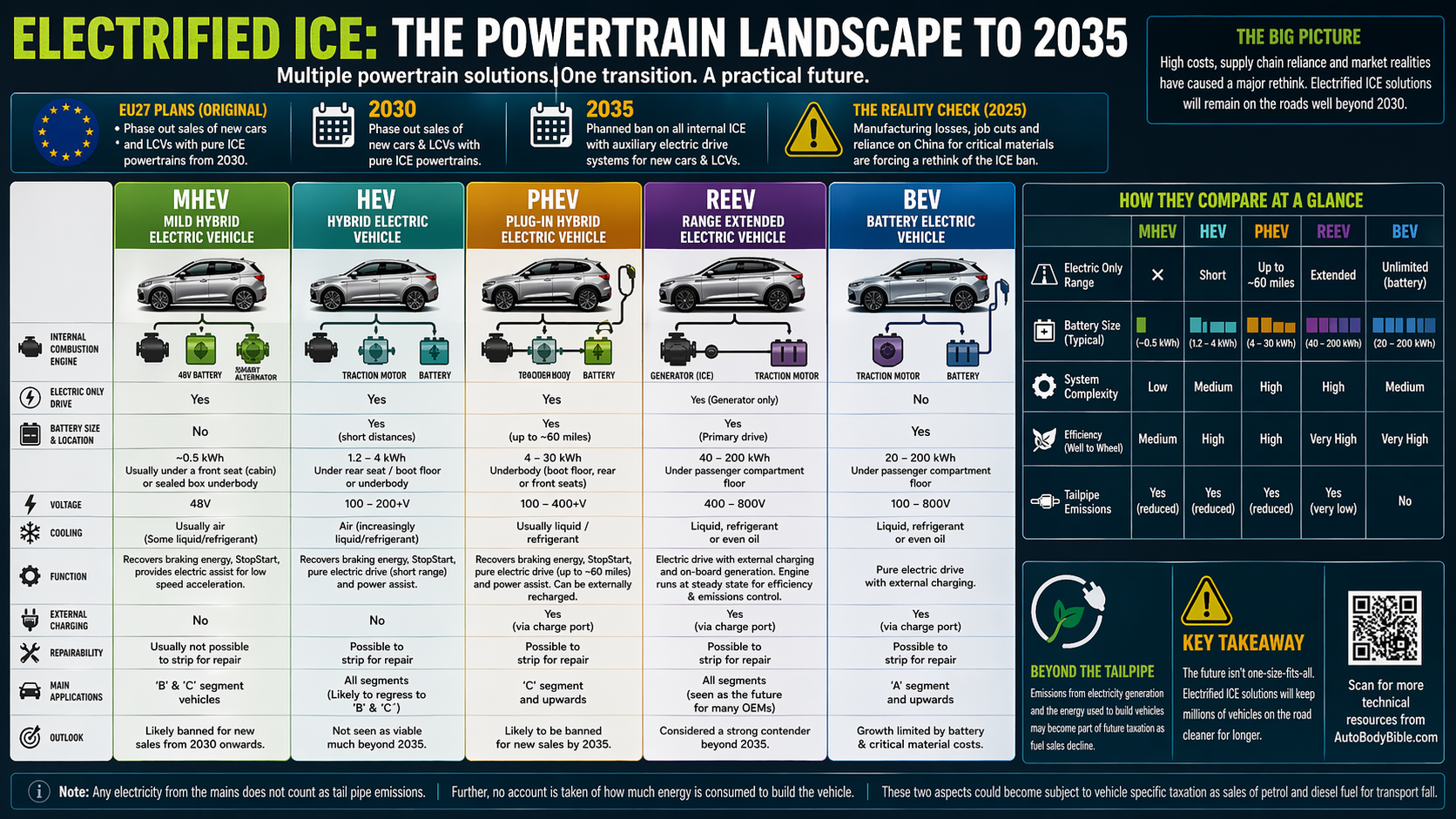
Here’s a guide to the main powertrain systems that will be sold in new cars and LCVs until around at least until 2035:
Mild Hybrid Electric Vehicle (MHEV)
- Internal combustion engine: Yes
- Capable of electric only drive: No
- Typical battery size and location: Lithium Ion, around 0.5 kWh, 48V, usually inside the passenger compartment under one of the front seats, but some manufacturers have placed the module in a sealed box on the underside (Land Rover / Range Rover, for example).
- Cooling: Usually air, but some liquid / refrigerant cooled units now appearing.
- Function: Capable of turning engine braking energy into stored energy via a smart alternator, engine re-start (‘StopStart’) and to allow electric power to assist the engine during lower speed acceleration, where most of the emissions occur. No external charging is possible.
- Repairability: Usually not possible to strip for repair.
- Main applications: ‘B’ (Peugeot 208) and ‘C’ (Volkswagen Golf) segment vehicles as emission laws tighten. Likely to be effectually banned for new car and LCV sales from 2030 onwards.
Hybrid Electric Vehicles (HEV)
- Internal combustion engine: Yes
- Capable of electric only drive: Yes, for relatively short distances. The motor is usually built into the transmission.
- Typical battery size and location: Lithium Ion, from 1.2 to 4 kWh, 100 to 200+V, usually either inside the passenger compartment under the rear seat / boot floor, or on the underside not far from the rear suspension.
- Cooling: Air, but as the battery duty cycle is increased, more commonly with liquid or refrigerant cooling.
- Function: Capable of turning engine braking energy into stored energy via a smart alternator, engine re-start (‘StopStart’), direct pure electric drive and electric power to assist the engine during lower speed acceleration, where most of the emissions occur. No external charging is possible.
- Repairability: Possible to strip for repair.
- Main applications: All segment vehicles, but likely to regress to ‘B’ (Peugeot 208) and ‘C’ (Volkswagen Golf) segments as emission laws tighten. Not seen by manufacturers has viable for new car and LCV sales much beyond 2035.
Plug-in Hybrid Electric Vehicles (PHEV)
- Internal combustion engine: Yes
- Capable of electric only drive: Yes, for anywhere up to 60 miles. The motor is usually built into the transmission.
- Typical battery size and location: Lithium Ion, around 4 to 30 kWh, 100 to 400+V, located on the underside – under the boot floor or under the rear seat or even under the front seats.
- Cooling: Usually liquid / refrigerant.
- Function: Capable of turning engine braking energy into stored energy via a smart alternator, engine re-start (‘StopStart’), direct pure electric drive and electric power to assist the engine during lower speed acceleration, where most of the emissions occur. The battery can be recharged via an external charge port – but few systems record this, which means users can buy a new vehicle with tax breaks as a PHEV but use them in effect like an HEV.
- Repairability: Possible to strip for repair.
- Main applications: ‘C’ segment vehicles (Volkswagen Golf) and upwards, but given legislator dislike for PHEVs, new car and LCV sales are likely to be banned by 2035.
Range Extended Electric Vehicles (REEV)
- Internal combustion engine: Yes
- Capable of electric only drive: Yes. The engine is usually not connected to the mechanical drive system, but generates electricity on demand.
- Typical battery size and location: Lithium Ion, 40 to 200 kWh, 400 to 800V, usually under the passenger compartment floor.
- Cooling: liquid, refrigerant or even oil.
- Function: An electric drive system with the capability for external charging via a charge port and on-board power generation. The engine is cheaper as a system than a hydrogen fuel cell, takes up less space and uses a fuel already widely available at lower cost than pure hydrogen. The engine works under steady state speed / load, which allows for much tighter tail pipe emission management by eliminating most transient load conditions.
- Repairability: Possible to strip for repair.
- Main applications: Now seen as the future for all ICE powertrains by many vehicle manufacturers, although the prospect of banning after 2035 remains a risk. Seen this before? Yes, the Vauxhall Ampera / Chevrolet Volt.
Battery Electric Vehicles (BEV)
- Internal combustion engine: No, just an electric motor
- Capable of electric only drive: Yes.
- Typical battery size and location: Lithium Ion, 20 to 200 kWh, 100 to 800V, usually under the passenger compartment floor.
- Cooling: liquid, refrigerant or even oil.
- Function: An electric drive system with the capability for external charging via a charge port.
- Repairability: Possible to strip for repair.
- Main applications: ‘A’ segment vehicles (Dacia Spring) and upwards, but crucially limited by the cost of the processed materials found in the traction motor, inverter and battery – especially the battery. Oddly China is the dominant source of all this material, and the main competitor when it comes to cut price BEVs.
Note: Any electricity from the mains does not count as tail pipe emissions. Further, no account is taken of how much energy is consumed to build the vehicle. These two aspects could become subject to vehicle specific taxation as sales of petrol and diesel fuel for transport fall.