Recently I was asked during a discussion about collision repair shop labour rates if modern cars are more complex. The quick answer is…. yes.
Considering all the possible repair jobs on a typical recently introduced European / Japan / South Korea model, the number of documents is around 800 to 1200, depending on the style of the vehicle manufacturer. If we look back to vehicles which left the market by 2018 (i.e., engineered before 2010) which in the main had little or no ADAS in the case of inexpensive models, that total is around 400 documents.
If the document is considered to be the definition of a process to remove and fit a part, there’s a simple metric that explains, yes, newer vehicles really are more complex.
Let’s delve a little deeper into this.
Multiple layers
In manufacturing every single vehicle starts with some form of body structure made from multiple parts which is then sealed and painted, which has many, many parts are fitted to it subsequently. Each task is broken down into units of around 2 minutes, which is linked to the speed and length of the assembly line – and assembly line that moves in lock step from pressing panels through to just-in-time delivery trackside of everything from SRS airbags to entire sets of seats.
Of course, collision repair is not the same as manufacturing.
So, whereas an assembly line has to cope with no more than two or three body styles, a collision repairer has to cope with almost anything turning up outside the business. Similarly, the bit that’s done any work in managing collision impact energy, the body, is buried beneath a whole gaggle of parts.
Getting to the core of the repair means taking of multiple layers of parts.
The more complex the vehicle, the more layers there are, the longer it takes.
Consider a Holden Commadore VX.
On the one hand it was not unsophisticated, but when compared to Holden Commadore VF it was relatively simple. Further, sales dominated the market, so repairers quickly found reliable ways to strip away parts efficiently to get to the repair zone by virtue of practice.
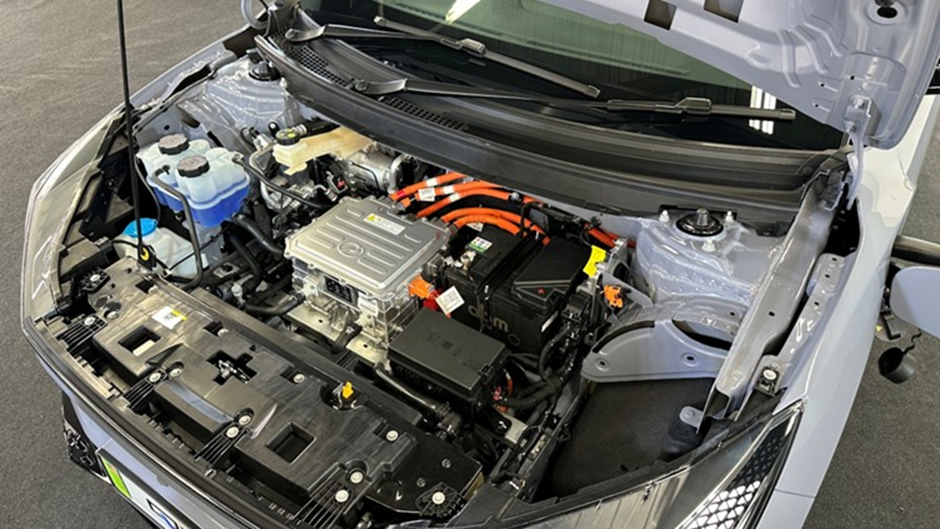
Now consider today. Not only is there considerable proliferation of possible powertrains (hybrid, plug-in hybrid, pure electric) but a whole host of other systems as well. To compound this, there are fewer big volume sellers, meaning more models chasing a given new vehicle market. This leads to less opportunity to develop those great ways to remove entire sub-assemblies rather than component by component to reach the required repair zone.
While the Bugatti Tourbillon is super-fast, and super complex, just take a look at the latest Perodua – a typical mass market pure electric drive vehicle. While the body can take more people and more luggage as well as accelerating without whiplash, the front end is full to the brim with systems.
What can a ‘system’ include?
The engineering systems used to create drawings for the Holden Commadore VX were in the main electronic, but the way the process worked was similar to a manual drawing. Each designer had to visualise how parts would fit together, across other systems.
Here’s an example of a modern system.
The base vehicle will have a manual transmission internal combustion engine powertrain. To comply with prevailing legislation and so be legal to sell, the tail pipe emissions need to be controlled. So, we shall add but one system of the may systems required to do this: EGR (exhaust gas recirculation).
It will have:
- A revised exhaust manifold with a take-off port for exhaust gas.
- A revised intake manifold with a port to allow exhaust gas to enter it.
- A valve to allow exhaust gas to be controlled.
- A cooler to reduce the exhaust gas temperature entering into the intake manifold.
- Pipes / gaskets to link the two manifolds, the cooler and valve together.
- Coolant hoses for the cooler.
- Clamps, screws and brackets.
If we add serum dosing, particulate filter regeneration, an electric drive system in addition to the engine – each will attract a gaggle of features such as ‘EGR’ complete with all the bits to make it work. Every single part is in addition to our relatively simple starting point.
If that enhanced vehicle is in a smash, all of those bits need to be removed before we can reach the body.
Is there a move to integration?
Let’s open the hood of the Holden Commadore VX and take in the relative space around the engine. In part this is down to fewer add on systems, but it’s also down to making fewer parts do more jobs. A favourite of modern powertrain design is to make the most amazing intricate pipe assemblies, which take less than a few seconds to fit in manufacturing. Yet, inevitably, they mask access to major fixings, can easily be damaged during impact or even in subsequent removal thanks to those lovely fixings rotting.
What happened?
The old way was to make castings, for example, carry internal ducts to carry fluids. Tesla did this with the ‘super manifold’ which first appeared on Model 3, making a front strut tower cross brace perform several other tasks as well. In the battle of the European automotive business for survival, there is a move to make fewer parts do more jobs, so reducing assembly cost during manufacture.
What could the flip side be?
As always there is a balance to be found. Highly functional parts become more difficult to repair. A classic example from the early 2000s was a BMW V8 eutectic aluminium alloy engine block with integral mounting pads for the engine mounts, which broke off in relatively minor impacts resulting in… a new engine block. It was in effect unrepairable.
The collision repair business needs to be able to keep vehicles alive for longer, so that we have a more prosperous long-term business. The issue is with pressure on vehicle values and complexity not only in the products but also the smaller number of any single model being sold, makes throwing away the vehicle more likely than less.
Are there any certainties in the future of collision repair?
Increased vehicle complexity and the effect on increased job times to do repairs due to stripping back more systems to reach the required zone is a very real problem.
However, not all vehicles in use are new, or even nearly new. The majority of the vehicle population are more closely related to Holden Commadore VF than any vehicle launched for the first time now. Repairers should be rewarded accordingly:
- A brand-new model / type needs proper research of all the repair documents, and that will scope how many systems need to be taken apart along with requirements for recommissioning them when the repair is complete. The residual value of the vehicle will be higher, so there’s more room to work before it becomes an economic write-off.
- A 10-year-old vehicle, especially one that’s quite common, needs a refresher session to ensure the correct documents are at hand, and the full repair is scoped. However the research time will be reduced thanks to retained knowledge, there is less likelihood of needing to recalibrate things such as ADAS, so the allowable repair cost per hour will be lower.
- This means a repairer will get the opportunity to work on a range of vehicle rather than being governed by the most expensive labour rate regardless of vehicle value. More repairs, more profit.
This is the start of a discussion.
For those who don’t physically repair vehicles there needs to be more awareness of what is involved and how that changes with respect to vehicle age. A list of part numbers and hours won’t really convey that.
For those who more often than not are paying repairers there needs to be a discussion about how vehicles presently going to salvage get the opportunity to be repaired instead – and yes, that will involve discussions about how much money a repairer gets paid per job. The discussion will also involve what type of things could be done to limit costs by allowing repairers to use – with the specific permission of the insurer / vehicle owner – cheaper paint systems or green parts.
Rest assured, the automotive business is rarely dull, and there’ll be another ‘major drama’ along any moment now…