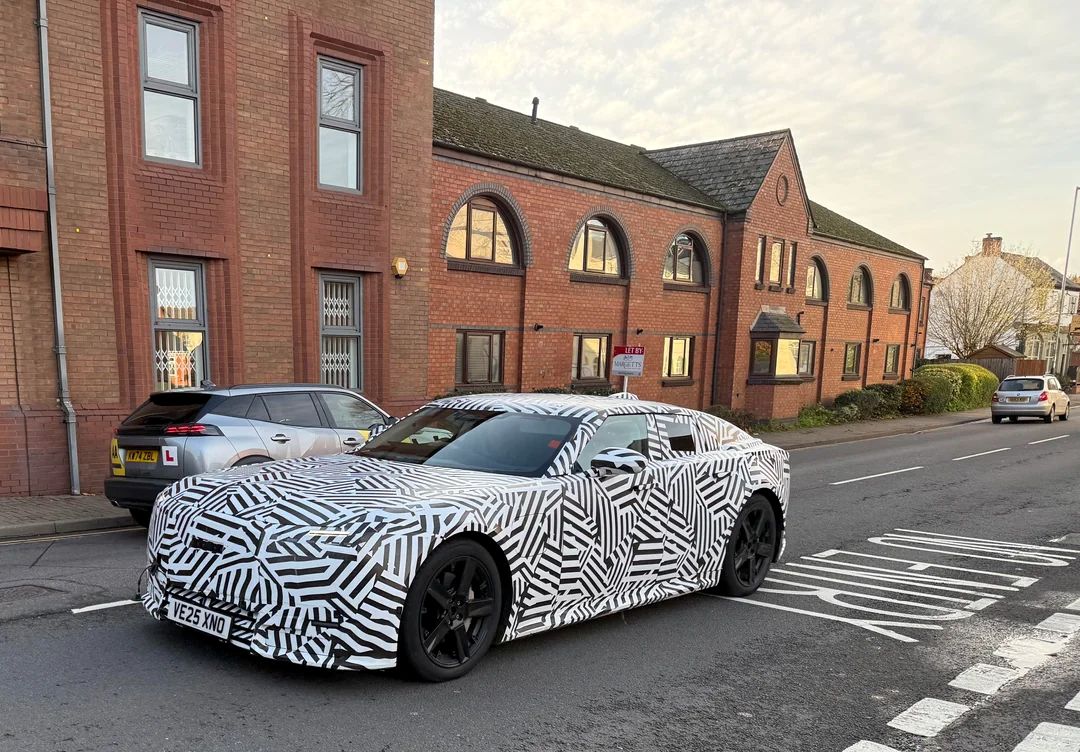
Spotted in Warwickshire, the new Jaguar GT prototype in these photos is more than an incredible sighting for Reddit user FlawlessC0wboy. Against all the odds, the immense ructions within JLR, the controversial rebrand for ‘jaGuar’, it is an early hint of the ultra-luxury Jaguar electric GT that will sit on the new JEA platform, with up to 430 miles WLTP range and a price tag more than £100,000.
While JLR have used aluminium intensive technology for bodyshells for over two decades, it is a near certainty the JEA platform will have some repair surprises.


What the Warwickshire photos show
From these street shots, you can pick out a few key points:
- Long bonnet, low roof line and short rear overhang – ‘cab rearward’
- Large wheels, essential for minimizing traction motor speeds, are placed not far behind the front bumpers, which should help with offset front impact performance.
- Although the camouflage disguises the panel cut lines and light details, we can see the cabin appears to be 2+2 (occasional rear seats)
- JLR routinely run close to production and pilot build vehicles around the area between the main engineering centres at Whitley and Gaydon.
Based on public information about the GT and the Type 00 concept, it is reasonable to treat this as an early near-production mule on the Jaguar Electric Architecture (JEA) platform.
High-level technical picture
From Jaguar’s own material and industry reporting:
- First of three new EVs on JEA, built in Solihull
- 800 V architecture, targeted 200 miles of charge in about 15 minutes
- WLTP range up to around 430 miles, and a top variant quoted at roughly 986 bhp
- No internal combustion or hybrid versions at all on this platform
For you, that means a large, heavy, high-output battery GT, with seriously large battery packs – although we don’t yet know where (clue – its not under the floor) and a lot of cutting edge software.
Now let’s break down what that means.
Body structure and exterior repair
Construction assumptions
Jaguar has already said the dramatic Type 00 proportions only work because of a clean-sheet EV platform.
Based on typical JLR practice and the segment, you should expect:
- Aluminium-intensive body-in-white, possibly with cast structural nodes at the suspension towers and battery crossmembers
- Mixed materials in closures and hang-on panels, for example, aluminium doors and bonnet, composite bumpers, and local hot-formed steel in crash load paths
- Bonded and riveted joints rather than traditional spot welds in large parts of the shell
Implications for your shop:
- Sectioning will be tightly restricted, along with restricted access to key repair tools. JLR are keen to assist repairers in understanding segregation of aluminium alloy and steel alloy materials during the repair process to avoid cross contamination, which can cause major refinishing issues long after completion of the work.
- You will need approved bonding products and squeeze-type rivet tools that meet Jaguar’s specs, plus training on adhesive curing, surface prep and corrosion protection.
- Straightening the body structure will be more limited than a steel alloy shell.
Exterior design and access
Spy material on the GT shows a small rear hatch with no traditional rear window, instead using cameras. This has already been seen on Polestar No4 and No5.
The major concern will be the nature and weight of the large front end skin panels. As usual, cosmetic damage that appears light may still require multiple calibrations after the repair process is completed.
Chassis, suspension and alignment
JEA is designed as a high-end performance EV platform, so expect something in line with current premium practice:
- Multi-link suspension front and rear, probably with adaptive air suspension and active damping
- Big brakes and an electronic parking brake integrated into the rear callipers
- Dual-motor variants with torque vectoring and excellent ESC control
What does that mean for your workshop:
- Wheel alignment becomes a software job as well as a mechanical one. Ride height must be set correctly cars before four wheel alignment, and subsequent ADAS calibration.
- The HV traction battery could well be distributed rather than in a single assembly, but due to the weight, jacking and lift points will matter to avoid damaging the underside.
Thermal management and the 800 V battery
The JEA architecture uses an 800 V system with around 100 kWh battery in concept form, targeting fast-charging of 200 miles in 15 minutes.
That brings a few points for accident repair:
- There will be separate thermal loops for:
- Battery
- Power electronics and e-motors
- Cabin, via a heat pump
- Cooling performance is central to pack life and fast-charge capability, so monitoring the battery control module activity is crucial during the repair process.
In practice:
- Any impact to the floor or sill near the traction battery pack will almost certainly trigger “battery damage inspection” procedures.
- You must treat all orange high-voltage harness lines and connectors as components that can only be opened by trained staff with isolation procedures in place
High-voltage safety and service
JLR has been clear that this platform is EV only, with no hybrid or ICE versions. Key implications:
- The 100 kWh traction battery poses a serious risk to personnel and the business if not handled correctly.
- Top variants near 986 bhp will draw serious current, so contactors, inverters and busbars will be substantial pieces of hardware.
For you:
- HV isolation procedures cannot be optional. You need:
- Level 3 EV competence in-house for safe power-down, lockout and verification
- Insulated tools, CAT III/IV meters, appropriate PPE and fire plans for thermal events
- Clear zoning in your shop for live, safe and quarantined EVs
If you plan to work on structural damage near the battery, you will likely need to be approved by Jaguar’s repair network due to the associated liability.
ADAS, sensors and calibration load
Type 00 and the GT mule point toward heavy use of cameras and radar, including camera systems replacing traditional mirrors and rear glass.
For bodyshops:
- Expect radar and camera modules in bumpers, grille, mirrors, tailgate and the upper rear structure.
- After even modest panel work, you will be looking at:
- Static and dynamic ADAS calibration
- Re-learn procedures linked to steering angle, ride height and wheel alignment
- Paint thickness over radar zones will be controlled, so heavy filler or multiple resprays in radar areas will cause problems.
If you do not have an ADAS calibration bay yet, this type of car will push you towards one.
What you should start planning for
If this Warwickshire prototype is any guide, the new Jaguar GT will arrive as a high-value, high-complexity EV. To handle it confidently, you should start to:
- Update training
- EV levels 2 and 3 for all techs who might touch the car
- Specific courses on aluminium and mixed-material structures, bonding and riveting
- Review equipment
- Non-conductive lifting pads and updated lift-point data
- Rivet tools, structural adhesives and curing systems that match JLR approvals
- ADAS calibration kit and wheel alignment systems that link to OEM data
- Clarify your repair scope
- Decide if you want to chase full OEM approval for this sort of vehicle
- Or focus on cosmetic work and light structural repairs, passing heavy hits to OEM centres